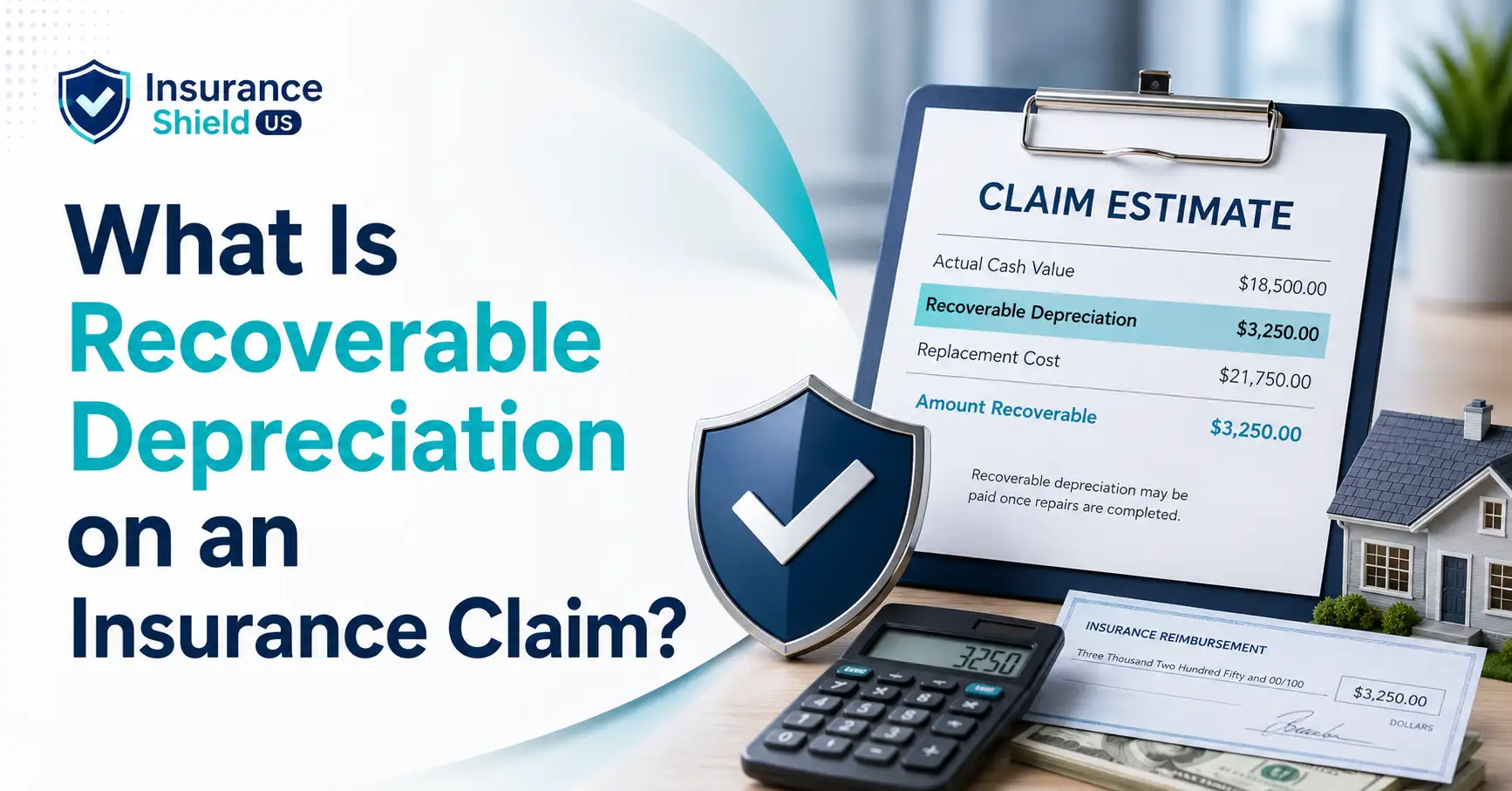
You receive a claim estimate showing $20,000 in covered repairs, but the first insurance check is much smaller than expected.
After looking through the paperwork, you notice terms such as “replacement cost value,” “actual cash value,” and “recoverable depreciation.” The estimate may even show several thousand dollars being withheld.
That missing amount is not always a denial or mistake. In many replacement-cost claims, the insurer initially pays the depreciated value of the damaged property and holds back the recoverable depreciation until you complete the repairs or replace the damaged item.
The frustrating part is that many settlement letters do not explain this process clearly. A homeowner may assume the first payment is the full settlement, miss a deadline, or complete repairs without saving the documents needed to collect the remaining money.
Quick Answer: Recoverable depreciation is the portion of an insurance claim that may be paid after damaged property is repaired or replaced. It is generally the difference between the property’s replacement cost value and its actual cash value. To receive it, you usually need replacement-cost coverage, proof of completed work or replacement, and compliance with the deadline and documentation requirements in your policy.
What Does Recoverable Depreciation Mean?
Depreciation is the estimated loss in an item’s value because of its age, condition, wear and tear, or expected useful life.
Suppose a new roof would cost $20,000, but the damaged roof was already 10 years old. The insurance company may calculate that the roof had lost $5,000 of its value before the storm.
That $5,000 is depreciation.
If your policy provides replacement cost coverage, the depreciation may be recoverable. This means the insurer may initially withhold it but release some or all of it after you repair or replace the roof according to the policy’s requirements.
The National Association of Insurance Commissioners explains that an insurer may initially pay only the actual cash value on a replacement-cost claim. Once the policyholder provides evidence that the damaged property was repaired or replaced, the insurer may pay the difference up to the covered replacement cost.
What Is the Difference Between RCV, ACV and Recoverable Depreciation?
These three terms usually appear together on an insurance estimate.
Replacement Cost Value
Replacement cost value, commonly shortened to RCV, is the estimated cost of repairing or replacing damaged property with property or materials of similar kind and quality, without subtracting depreciation.
RCV does not necessarily mean the most expensive replacement available. The payment remains subject to the policy’s limits, exclusions, approved scope of work, and loss-settlement terms.
The NAIC describes replacement-cost coverage as coverage for repairing or replacing damaged property with materials of like kind and quality without the same depreciation deduction used in an actual-cash-value settlement.
Actual Cash Value
Actual cash value, or ACV, is generally the replacement cost minus depreciation.
The insurer considers the damaged item’s age, condition, wear and tear, and remaining useful life when calculating its depreciated value. An older roof, appliance, carpet, or piece of furniture may therefore have a substantially lower ACV than the cost of purchasing a new replacement.
Recoverable Depreciation
Recoverable depreciation is the difference between the replacement cost and actual cash value that may be available after repair or replacement.
A simple formula is:
Replacement Cost Value − Actual Cash Value = Recoverable Depreciation
The deductible is normally a separate part of the claim calculation.
How Is Recoverable Depreciation Calculated?
Consider a covered roof claim with the following amounts:
| Claim calculation | Amount |
|---|---|
| Replacement cost value | $20,000 |
| Depreciation withheld | $5,000 |
| Actual cash value | $15,000 |
| Policy deductible | $1,500 |
| Initial claim payment | $13,500 |
| Potential recoverable depreciation | Up to $5,000 |
| Potential total insurer payment | Up to $18,500 |
The insurer starts with the $20,000 replacement estimate and subtracts $5,000 for depreciation. That produces an actual cash value of $15,000.
After subtracting the $1,500 deductible, the initial payment would be $13,500.
Once the covered roof replacement is completed and the required documents are accepted, the policyholder may receive up to another $5,000 in recoverable depreciation. The policyholder still remains responsible for the $1,500 deductible.
This example assumes that:
- The roof damage is covered.
- The policy provides replacement-cost settlement.
- The work is completed on time.
- The replacement complies with policy requirements.
- The final covered cost supports the additional payment.
- The claim does not exceed applicable policy limits.
Your insurer’s calculation may be different because policies, state rules, estimates, deductibles and claim facts vary.
Use the Deductible vs Premium Calculator when you need a basic explanation of how a deductible affects your out-of-pocket insurance costs. The calculator cannot estimate recoverable depreciation or determine a specific claim payment.
Why Does the Insurance Company Withhold Depreciation?
A replacement-cost policy is generally intended to help repair or replace covered damaged property—not automatically provide the full cost of new property when no replacement occurs.
The insurer may therefore release the claim in stages:
- An initial actual-cash-value payment
- An additional replacement-cost payment after repair or replacement
This process gives the policyholder money to begin the work while allowing the insurer to confirm that the damaged property was actually repaired or replaced.
The Insurance Information Institute explains that replacement cost reflects the cost of an item of similar kind and quality without deducting depreciation, while actual cash value subtracts the loss in value caused by age, obsolescence, wear and other factors.
Not every replacement-cost claim follows exactly the same payment process. Your settlement letter and policy’s “Loss Settlement” section should explain whether depreciation has been withheld and what must happen before it is released.
Is Recoverable Depreciation Guaranteed?
No.
Seeing a depreciation amount on an estimate does not guarantee that the full amount will eventually be paid.
You may need to satisfy several conditions:
- The damaged property must be covered.
- Your policy must provide replacement-cost coverage for that property.
- The estimate must identify the depreciation as recoverable.
- The repair or replacement must be completed.
- You must submit acceptable proof.
- The work must be completed within the applicable deadline.
- The final cost must support the amount requested.
- The claim must remain within policy limits and terms.
The word “recoverable” means the amount may be claimed after the required conditions are met. It does not mean the payment is automatic.
What Is Nonrecoverable Depreciation?
Nonrecoverable depreciation is depreciation that the insurer does not intend to pay later under the applicable policy terms.
This may happen when:
- The policy settles the property only at actual cash value.
- A roof endorsement limits an older roof to ACV.
- Replacement-cost coverage does not apply to that category of property.
- The property is not repaired or replaced.
- A policy condition or deadline is not satisfied.
- The estimate marks a particular amount as nonrecoverable.
For example, your home may have replacement-cost coverage while an endorsement changes the roof settlement to actual cash value after the roof reaches a certain age.
In that situation, depreciation on the roof may not be recoverable even though other parts of the home have replacement-cost protection.
This is one reason policyholders should not assume that every part of a homeowners policy uses the same loss-settlement method. The California Department of Insurance similarly explains that replacement-cost and actual-cash-value settlements can produce very different payments because ACV accounts for the property’s reduced value.
Review the How to Know If You’re Underinsured guide to understand how replacement-cost terms, roof settlement provisions, deductibles and policy limits can create unexpected out-of-pocket costs.
How Do You Know Whether Depreciation Is Recoverable?
Start with the insurer’s estimate or claim summary.
Look for columns or abbreviations such as:
- RCV
- ACV
- Depreciation
- Recoverable depreciation
- Nonrecoverable depreciation
- Amount withheld
- Net claim
- Replacement-cost benefits
Some estimates use abbreviations such as “RCV,” “ACV” and “DEPREC.” Others show depreciation separately for every damaged item.
For example, a personal-property estimate might list:
| Damaged item | RCV | Depreciation | ACV |
|---|---|---|---|
| Television | $900 | $300 | $600 |
| Sofa | $1,500 | $600 | $900 |
| Laptop | $1,200 | $400 | $800 |
Do not rely only on the totals at the bottom. Check whether each depreciation amount is marked recoverable or nonrecoverable.
You should also read:
- The declarations page
- The property coverage section
- The loss-settlement provision
- Relevant endorsements
- The claim payment letter
- The adjuster’s estimate
- Any deadline notice
Use the Insurance Coverage Gap Checker to organize general questions about replacement-cost coverage, deductibles, exclusions, limits and outdated policy terms. It cannot read the claim estimate or confirm that your depreciation is recoverable.
How Do You Claim Recoverable Depreciation?
Step 1: Review the Settlement Documents
Do not assume the first check is the insurer’s final payment.
Read the claim letter and estimate carefully. Identify the RCV, ACV, deductible, withheld depreciation and initial payment.
Ask the adjuster to explain any amount you do not understand.
Step 2: Confirm the Deadline in Writing
Ask the insurer:
What is my deadline for completing repairs or replacement and submitting a recoverable depreciation request?
Do not rely only on a telephone conversation. Request the answer by email or letter and keep it with your claim records.
The NAIC’s post-disaster guidance warns that policies and state rules commonly impose a time limit for claiming recoverable depreciation. It also advises policyholders to contact their adjuster or state insurance department when they have questions about the deadline or need additional time.
Step 3: Confirm What Evidence the Insurer Requires
Different insurers may request different records.
Common examples include:
- Final contractor invoice
- Signed work-completion statement
- Proof of payment
- Receipts
- Replacement purchase records
- Before-and-after photographs
- Cancelled checks or transaction records
- Updated repair estimate
- Certificate of completion
- Itemized personal-property replacement list
The Insurance Document Checklist Generator can help organize damage photos, contractor notes, repair estimates, receipts, proof of ownership and insurer correspondence before you submit your request.
Step 4: Complete the Covered Repair or Replacement
Use the approved estimate as a starting point, but discuss significant differences with the adjuster.
If your contractor discovers hidden covered damage or says the insurer’s scope is incomplete, notify the insurer before assuming the additional amount will be paid.
Ask whether a supplemental estimate, reinspection or prior approval is required.
Step 5: Keep an Itemized Record of Costs
A single total on a contractor invoice may not be enough when the insurer needs to match completed work with individual estimate items.
Ask for an invoice showing:
- Work completed
- Materials used
- Labor charges
- Dates of service
- Amount paid
- Remaining balance
- Contractor’s contact information
Keep proof of deposits and progress payments as well as the final invoice.
Step 6: Submit a Written Request
Send the insurer a short written request stating that repairs or replacements are complete and that you are requesting the recoverable depreciation.
Include the claim number and attach the required evidence.
A simple message could say:
The covered repairs identified in the attached documents have been completed. Please review the enclosed invoices, receipts and proof of payment and release any recoverable depreciation available under the policy.
Keep a copy of everything submitted.
Step 7: Review the Additional Payment
Compare the insurer’s second payment with the recoverable depreciation shown on the original estimate.
A lower payment does not automatically mean an error. The final benefit may be affected by the actual covered cost, policy limits, incomplete items, excluded upgrades or other settlement conditions.
However, ask for a written breakdown if the payment is lower than expected.
What Happens If Repairs Cost Less Than the Insurance Estimate?
Suppose the insurer estimates $20,000 for covered repairs, but the completed work costs $18,000.
You should not automatically expect to receive the entire original $20,000 estimate. Replacement-cost coverage commonly focuses on the covered cost of repairing or replacing the property, subject to the insurer’s estimate, policy limit and settlement terms.
Using the earlier example:
- Initial payment: $13,500
- Actual completed repair cost: $18,000
- Deductible: $1,500
- Potential total covered payment: $16,500
- Potential additional payment: $3,000
The insurer may therefore release $3,000 rather than the full $5,000 initially shown as potentially recoverable.
This is only a simplified example. Ask the adjuster how your policy handles final costs before making financial decisions.
What Happens If Repairs Cost More Than the Estimate?
Higher costs do not automatically mean the insurer must pay the difference.
First determine why the contractor’s price is higher.
Possible reasons include:
- The insurer missed covered damage.
- Local labor or material prices changed.
- The contractor included upgrades.
- Building-code work is required.
- The contractor’s scope differs from the insurer’s scope.
- Hidden damage was discovered during repairs.
- The contractor included work unrelated to the covered loss.
Send the contractor’s itemized estimate to the adjuster and request a written review. Do this before completing disputed work whenever reasonably possible.
Keep communication records and confirm whether the insurer wants to reinspect the damage.
Can You Receive Recoverable Depreciation Without Making Repairs?
Usually, recoverable depreciation is tied to completing the covered repair or replacement.
When the property is not repaired or replaced, the insurer may limit the settlement to actual cash value. The NAIC explains that the additional amount is generally paid after evidence of repair or replacement is presented.
There may be exceptions or different settlement provisions, so read the exact policy rather than relying on a general rule.
Do not submit false invoices, inflated receipts or statements claiming that work was completed when it was not. Inaccurate claim information can create serious coverage and fraud issues.
Does Recoverable Depreciation Apply to Personal Property?
It can.
Replacement-cost coverage may apply to belongings such as furniture, electronics, clothing and appliances. The insurer may initially pay each item’s depreciated actual cash value and then pay additional replacement-cost benefits after you purchase a replacement.
Consider a five-year-old television:
- Replacement cost: $1,000
- Depreciation: $400
- Initial ACV: $600
- Possible additional payment after replacement: up to $400
Save the purchase receipt and make sure the replacement reasonably matches the type and function of the damaged item.
Ask the insurer whether you must replace each item individually or whether claim rules allow another method. The answer depends on the policy and claim process.
How Long Do You Have to Recover Depreciation?
There is no single deadline that applies to every U.S. insurance claim.
The deadline may be controlled by:
- The policy
- An endorsement
- State insurance law
- A disaster-related extension
- A written agreement with the insurer
- The date of loss
- The date of the initial payment
Do not wait until repairs are finished to investigate the deadline.
The NAIC advises policyholders to ask the adjuster about the applicable time frame and to contact the state insurance department when clarification is needed. Extensions may sometimes be available, particularly when widespread disasters delay repairs, but they should not be assumed.
The Claim Denial Risk Checker can help you review general concerns involving deadlines, missing proof, policy status and incomplete documentation. It cannot determine the legally enforceable deadline for your particular claim.
What Should You Do If the Insurer Will Not Release the Depreciation?
Start by asking for a written explanation.
Request:
- The specific reason payment was reduced or refused
- The relevant policy provision
- A detailed depreciation calculation
- A list of missing documents
- Confirmation of the filing deadline
- Identification of any unrepaired estimate items
- Instructions for requesting reconsideration
Compare the response with your settlement letter, invoices and policy.
A delayed payment may result from incomplete documentation rather than a final denial. The insurer may need a corrected invoice, proof of payment, clearer photographs or confirmation that all covered work was completed.
Use the Why Do Insurance Claims Get Denied? guide to review common problems involving documentation, policy conditions, deadlines and exclusions.
When you still disagree, consider contacting:
- The claim adjuster’s supervisor
- Your insurance agent
- A licensed public adjuster, where appropriate
- A qualified attorney
- Your state’s Department of Insurance
The NAIC also recommends contacting the relevant state insurance department for policy and claim guidance when necessary.
Common Mistakes to Avoid
Assuming the First Check Is the Final Payment
The first payment may represent only the actual cash value after depreciation and the deductible.
Read the estimate before deciding that the insurer has underpaid the entire claim.
Assuming Recoverable Means Automatic
Recoverable depreciation usually requires action. You may need to complete the work, submit proof and meet a deadline.
Missing the Replacement Deadline
A valid replacement-cost benefit may be lost or disputed when the policyholder waits too long.
Ask about the deadline immediately and request an extension in writing when delays are outside your control.
Throwing Away Receipts and Invoices
The insurer may require proof that money was actually spent on covered repairs or replacement property.
Store digital and paper copies of all claim documents.
Failing to Separate the Deductible From Depreciation
Your deductible and depreciation are different.
The deductible is the part of a covered loss assigned to you. Depreciation is the reduction in value based on age and condition.
Replacing Property Without Checking Requirements
A significantly different, upgraded or unrelated replacement may not produce the benefit you expect.
Ask how the insurer defines “like kind and quality” before making a major purchase.
Completing Extra Work Without Requesting a Supplement
Contractors often find additional damage after repairs begin.
Notify the insurer, document the damage and ask whether a supplemental estimate or reinspection is needed before covering the extra expense yourself.
Accepting a Verbal Explanation
Claim representatives may provide useful information over the phone, but important deadlines and document requirements should be confirmed in writing.
Renewing Without Reviewing the Settlement Method
At your next renewal, check whether the home, roof and belongings are covered at replacement cost or actual cash value.
The Insurance Renewal Checklist Generator can help you review deductibles, limits, exclusions, endorsements and claim-related policy changes before renewing.
The Bottom Line
Recoverable depreciation is money the insurer may temporarily withhold from a replacement-cost claim.
The insurer commonly begins with the property’s estimated replacement cost, subtracts depreciation to calculate actual cash value, and then applies the deductible. After the covered property is repaired or replaced and the required proof is submitted, some or all of the withheld depreciation may become payable.
The most important word is may.
Payment depends on your policy, the type of property, the final covered cost, documentation, deadlines and state rules. Read the estimate carefully, ask the adjuster for written instructions, keep detailed receipts and submit the recoverable-depreciation request before the deadline.
For additional claim-preparation resources, visit the Free Insurance Tools Hub, where readers can review coverage gaps, claim risks, deductibles, policy renewals and document requirements.
Educational Disclaimer
This article is provided for general educational and informational purposes only. It is not insurance, legal, financial, tax or claim-specific advice.
Coverage terms, depreciation calculations, deductibles, deadlines, exclusions and claim requirements vary by policy, insurer and state. Review your actual policy and settlement documents, and consult your insurance company, a licensed insurance professional, attorney or state insurance department regarding your individual situation.

I’m Muhammad Waqas, the creator of Insurance Shield US. I write simple insurance guides, checklists, and tool-based content to help everyday readers understand coverage gaps, claim risks, policy documents, and renewal mistakes. My content is for educational purposes only and does not replace advice from a licensed insurance professional.