You have only had your driver’s license for six months, you bought an older car with cash, and every insurance quote seems impossible.
One company wants $250 a month. Another asks for $400. A third quote comes back close to $500.
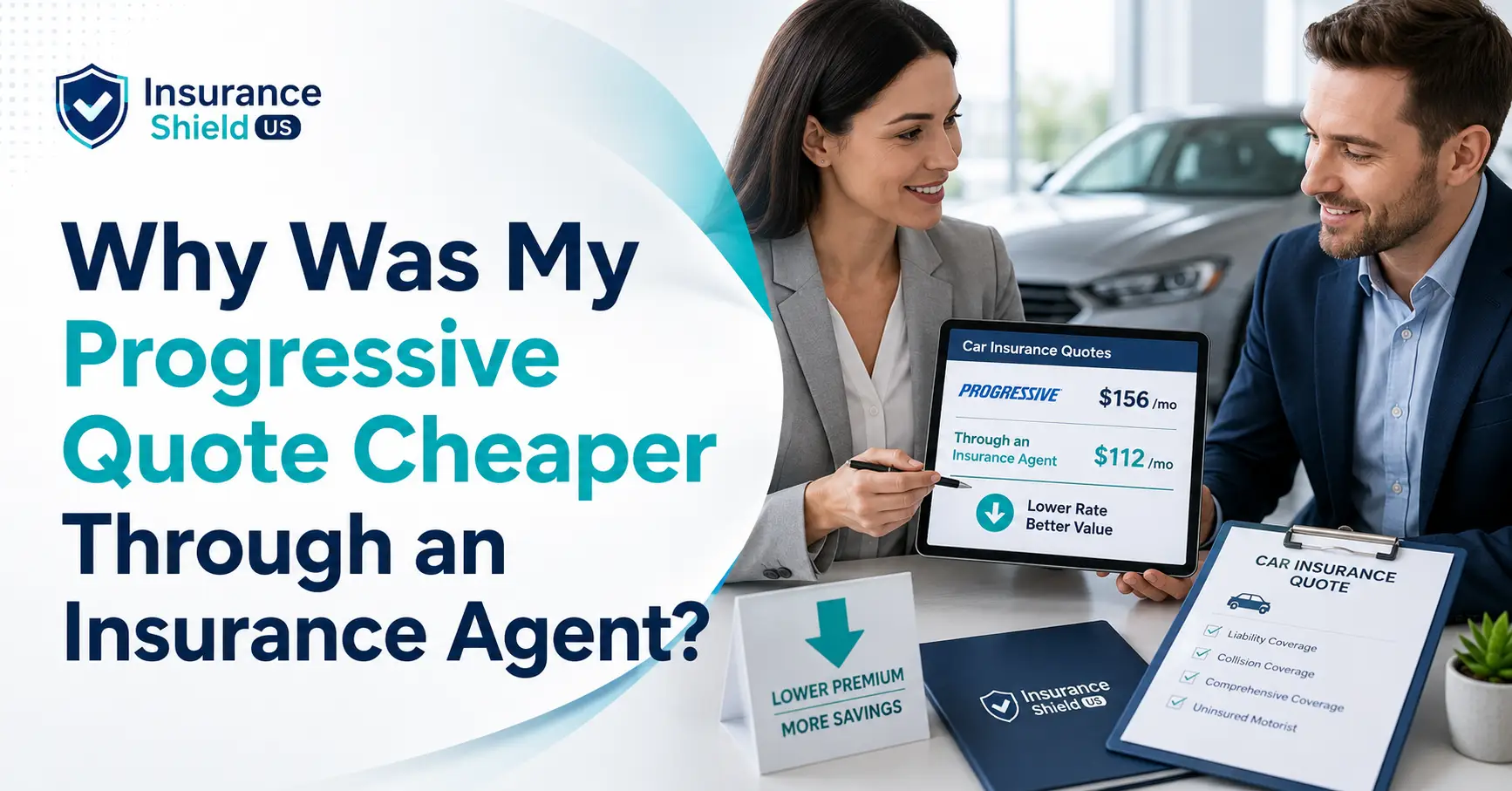
Then an insurance agency finds a Progressive policy for around $600 for six months—roughly $100 per month. The confusing part is that Progressive previously quoted you around $450 per month when you contacted the company directly.
It is reasonable to wonder whether the cheaper policy is real, whether something was entered incorrectly, or whether the agency has access to a secret discount.
A lower agency quote can be legitimate. Progressive openly states that its prices may vary depending on whether the policy is purchased directly, online, by telephone, or through an independent agent or broker. However, a difference as large as $100 versus $450 per month should still be investigated carefully. The two quotes may not contain the same coverage, deductibles, driver information, discounts, or payment structure.
Quick Answer: Progressive may charge a different rate through an independent insurance agency than through its direct sales channel. The cheaper quote may also use lower liability limits, exclude collision or comprehensive coverage, apply different deductibles, include additional discounts, or use more complete driver information. Before buying, compare both quotes line by line and confirm that the $600 figure is the total six-month premium—not merely the initial payment.
Can Progressive Really Charge Different Prices Through an Agent?
Yes.
Progressive sells auto insurance through more than one channel. A customer may buy:
- Directly from Progressive online
- Directly by telephone
- Through an independent insurance agent
- Through an insurance broker or shopping service
Progressive explains that prices can vary because each sales channel has different expenses and business arrangements. An agency-sold policy may include the cost of an agent’s commission, while a direct policy reflects expenses such as sales-center staffing and marketing.
This does not mean an agent will always be cheaper. It means the price generated through one channel is not guaranteed to match the price produced through another.
In the situation described above, the shopping service or agency likely acted as the intermediary while Progressive remained the actual insurance carrier.
That is an important distinction:
- The insurance agency helps gather information, compare options, explain coverage, and place the policy.
- The insurance carrier issues the policy, collects or processes premiums, and handles covered claims.
Before paying, confirm that the declarations page—the policy summary—identifies Progressive or another licensed insurer as the company providing coverage.
Why Might the Agency Quote Be So Much Cheaper?
The sales channel may explain part of the difference, but a drop from approximately $450 to $100 per month is large enough that several other factors should be checked.
1. The Cheaper Quote May Have Lower Coverage Limits
Two policies can both be described as “car insurance” while offering very different financial protection.
For example, one quote might include:
- $100,000 of bodily injury liability per person
- $300,000 per accident
- $100,000 of property damage liability
- Uninsured motorist coverage
- Collision coverage
- Comprehensive coverage
- Rental reimbursement
- Roadside assistance
The other quote might include only the minimum liability coverage required by the state.
The second policy will probably cost less, but it is not an equal comparison.
Most states require drivers to carry a minimum amount of liability insurance. Liability coverage generally helps pay for injuries or property damage you cause to other people. Collision and comprehensive coverage protect your own vehicle against different types of damage and are generally optional unless a lender or leasing company requires them.
Suppose a state allows a relatively low property damage limit and you cause a crash that totals a $45,000 vehicle. If your policy only provides $15,000 of property damage liability, you could potentially remain responsible for costs above the policy limit, depending on the circumstances and applicable law.
A low premium is only helpful when you understand what financial risk you are keeping.
Before choosing the cheaper quote, run a general review with the Insurance Coverage Gap Checker. It cannot determine the exact limits you need, but it can help identify exclusions, limits, deductibles, and policy areas to discuss with a licensed agent.
2. The Cash-Purchased Car May Not Have Collision or Comprehensive Coverage
Buying an older car with cash can reduce insurance costs because there is no lender requiring physical damage coverage.
A financed or leased vehicle generally requires collision and comprehensive coverage. A car owned outright can often be insured with liability-only coverage, provided the policy still satisfies state requirements.
That does not mean dropping collision and comprehensive is always the right choice.
Collision coverage generally helps pay for covered damage to your vehicle caused by a crash. Comprehensive coverage generally applies to covered losses such as theft, fire, vandalism, hail, flooding, or contact with an animal.
Take a driver who owns a car worth $3,000.
If collision coverage costs several hundred dollars per year and carries a $1,000 deductible, the driver may decide that paying for the coverage is not worthwhile. The maximum claim payment would generally be tied to the vehicle’s value, minus the deductible and subject to policy terms.
The Insurance Information Institute recommends doing the math before buying collision and comprehensive coverage for an older vehicle. The decision should consider the vehicle’s current value, premium, deductible, and whether the owner could afford to replace the car after a loss.
However, a driver who depends on that $3,000 car to get to work may still want comprehensive or collision coverage because replacing it immediately could be difficult.
The correct question is not simply, “Is this car cheap?”
It is:
“Could I afford to repair or replace this car tomorrow if it were stolen, totaled, or badly damaged?”
If the vehicle was financed rather than bought with cash, also review what GAP coverage on a car means before assuming ordinary auto insurance will pay the entire loan balance after a total loss.
3. The Deductibles May Be Different
A deductible is the amount you are responsible for paying toward certain covered claims before the insurer’s payment is calculated.
One quote may include:
- $250 comprehensive deductible
- $500 collision deductible
Another may include:
- $1,000 comprehensive deductible
- $2,000 collision deductible
The second quote could be considerably cheaper because the driver is accepting more of the initial claim cost.
Imagine a covered collision causes $2,400 of damage:
- With a $500 deductible, the covered amount after the deductible could start around $1,900.
- With a $2,000 deductible, the covered amount after the deductible could start around $400.
The actual payment depends on the policy, repair estimate, vehicle value, exclusions, and claim decision.
Use the Deductible vs Premium Calculator to compare the general trade-off between a lower monthly premium and a larger deductible. Do not choose a deductible that you would be unable to pay after an accident.
4. Different Information May Have Been Entered
Auto insurance rates depend on far more than how long someone has held a license.
The NAIC identifies common rating factors such as:
- Location
- Age
- Driving experience
- Driving record
- Claims history
- Previous insurance coverage
- Vehicle type
- Vehicle use
- Annual mileage
- Selected coverages
- Deductibles
- Credit-based information where permitted by state law
Some states restrict or prohibit the use of particular rating factors.
A small difference in the application can create a large price change.
For example:
- One quote may list the car as being used for a long daily commute.
- Another may list it as limited personal use.
- One may show a lapse in prior insurance.
- Another may identify existing coverage.
- One may use an incorrect ZIP code.
- Another may list the correct garaging address.
- One may include another household driver.
- Another may omit that driver.
- One may estimate 15,000 annual miles.
- Another may estimate 5,000.
These details must be accurate.
Do not intentionally provide a false address, mileage estimate, vehicle use, household-driver list, or insurance history to obtain a cheaper rate. Incorrect material information can lead to premium adjustments, policy cancellation, nonrenewal, or problems during a claim.
5. The Agency May Have Applied Discounts That Were Missed Before
Auto insurers may offer discounts for qualifying customers, but availability differs by state, company, driver, and sales channel.
Possible discounts may relate to:
- Automatic payments
- Paying the six-month premium in full
- Paperless documents
- Online signing
- Multiple vehicles
- Multiple policies
- Good students
- Driver education
- Vehicle safety equipment
- Anti-theft equipment
- Continuous insurance
- Usage-based driving programs
Progressive lists several discount categories, but no individual driver is guaranteed to qualify for all of them.
An experienced agent may ask questions that help identify legitimate discounts that were not included in the earlier quote.
However, discounts alone may not explain a reduction of several hundred dollars per month. The coverage and application details should still be compared.
6. One Quote May Have Been Preliminary
An insurance quote is an estimate based on the information available when it is created.
Before binding or finalizing a policy, the insurer may verify details using records such as:
- A Motor Vehicle Report
- Claims-history information
- Vehicle information
- Driver’s license records
- Prior-insurance information
The NAIC advises consumers that insurers may review motor vehicle and claims records when completing an auto insurance quote.
This means an attractive preliminary quote could change if the verified information differs from the original application.
Ask whether the policy has already been bound.
A bound policy generally means coverage has been placed with a specified effective date, subject to the policy’s terms and any remaining underwriting requirements.
Then check the actual:
- Policy number
- Effective date
- Expiration date
- Named insured
- Vehicle identification number
- Listed drivers
- Coverage limits
- Deductibles
- Total premium
- Payment schedule
Do not rely only on a text message or verbal statement saying the policy costs $100 per month.
7. The $600 May Not Mean What the Driver Thinks It Means
Auto insurance payment documents can show several different amounts:
- Total six-month premium
- Initial down payment
- Monthly installment
- Remaining balance
- Installment fee
- Automatic-payment amount
- Paid-in-full amount
A statement such as “$600 for six months” should mean that $600 is the total policy premium for the entire term.
But sometimes a shopper sees a $600 initial payment and assumes it covers the whole term when additional installments are still due.
Check the billing schedule for language such as:
- Total policy premium
- Amount due today
- Remaining premium
- Number of installments
- Installment fee
- Recurring payment amount
A genuine $600 six-month policy should normally show how the full $600 will be paid, whether in one payment or several installments.
Is Savvy Insurance the Reason the Rate Was Lower?
An insurance shopping service or independent agency may help a driver access agency-channel pricing, compare insurers, or complete an application more accurately.
That does not mean every driver will receive the same result.
A recommendation based on one person’s experience should not be treated as proof that the agency will always be cheapest. Rates are individualized, state-specific, and sensitive to small differences in the application.
Before using any insurance agency or online referral service:
- Confirm the agency’s full legal name.
- Verify that the agent or agency is licensed in your state.
- Confirm the identity of the insurance carrier.
- Read the privacy and consent language.
- Ask whether your information will be shared with other companies.
- Review the policy documents before paying.
- Contact the carrier independently if anything appears inconsistent.
The NAIC recommends confirming that both the insurance agent and company are properly licensed. Consumers can check through their state Department of Insurance or available NAIC resources.
Our guide, Is PolicyAutos Legit? What to Know Before Sharing Your Information, explains the difference between an insurer, an agency, a comparison service, and a lead-generation website. The same verification principles are useful whenever a website promises to help locate cheaper auto insurance.
How Can a New Driver Find Cheaper Insurance Safely?
Step 1: Decide What Coverage You Are Comparing
Before requesting quotes, write down the exact coverage you want.
For example:
- Bodily injury liability limits
- Property damage liability limit
- Uninsured and underinsured motorist coverage
- Personal injury protection or medical payments
- Comprehensive coverage
- Collision coverage
- Comprehensive deductible
- Collision deductible
- Rental reimbursement
- Roadside assistance
Use the same selections for every quote.
Otherwise, you may think one company is cheaper when it is simply offering less coverage.
Step 2: Get Quotes Through More Than One Channel
Try a combination of:
- Direct insurance-company websites
- Direct telephone quotes
- Independent insurance agents
- Captive agents who represent one insurer
- Reputable comparison services
The NAIC recommends shopping around because insurers use different guidelines and may charge different prices for similar risks.
Do not assume the first quote establishes the normal price for your profile.
Step 3: Compare the Total Six-Month Cost
Monthly payments are useful for budgeting, but the total term premium is the better comparison.
For example:
Policy A
- $95 per month
- $150 initial payment
- Five later installments
- Installment fees
- Total six-month cost: $650
Policy B
- $110 per month
- No large initial payment
- Total six-month cost: $660
The two policies are much closer in price than the monthly figures initially suggest.
Step 4: Review the Limits Before Raising the Deductible
A higher deductible may lower the price of collision or comprehensive coverage.
Lowering liability limits is a different decision. Liability limits affect how much insurance may be available when you injure someone or damage another person’s property.
Do not reduce both limits and coverage automatically just to reach a target monthly price.
Step 5: Ask About Legitimate Discounts
Ask each agent or insurer to explain:
- Which discounts were applied
- Which discounts require documentation
- Which may disappear at renewal
- Whether automatic payments are required
- Whether a usage-based program affects the initial or future rate
- Whether paying in full changes the cost
Usage-based insurance programs may consider driving information such as mileage, driving time, and driving behavior. Read the program terms and privacy disclosures before enrolling.
Step 6: Keep the Policy Active
A lapse in insurance can make future coverage more expensive and may create legal or registration problems depending on the state.
When switching insurers, do not cancel the existing policy until the new policy is confirmed, paid as required, and active.
Step 7: Shop Again at Renewal
A new driver’s first quote does not determine what they will pay forever.
Driving experience, insurance history, claims, violations, location, vehicle use, and company pricing may change.
Before the six-month policy ends, use the Insurance Renewal Checklist Generator to review:
- The new premium
- Coverage limits
- Deductibles
- Discounts
- Exclusions
- Payment terms
- Household changes
- Driving changes
- Competing quotes
Do not let the policy renew automatically without checking what changed.
What Common Mistakes Should New Drivers Avoid?
Comparing Prices Without Matching Coverage
A $100 policy and a $450 policy may not be equivalent.
Compare each coverage line, limit, deductible, and optional benefit.
Buying Only the State Minimum Without Understanding the Risk
State minimum coverage makes a policy legally compliant, but it may provide limited financial protection after a serious crash.
Ask a licensed professional what costs could remain above the limit.
Hiding Household Drivers
Insurers commonly ask about licensed people living in the household.
Do not omit someone simply because adding them increases the quote. Ask whether they must be listed, rated, excluded where legally permitted, or otherwise addressed.
Using the Wrong Address
The car should be insured using its actual primary garaging location.
Using a relative’s address or another ZIP code solely to obtain a cheaper price can create serious policy problems.
Choosing a Deductible You Cannot Pay
A $2,000 deductible may reduce the premium, but it will not help if you cannot produce $2,000 after an accident.
Assuming an Older Car Creates No Financial Risk
Your car may be inexpensive, but you could still cause extensive damage to someone else’s vehicle or seriously injure another person.
The value of your own car does not determine the full size of your liability exposure.
Paying Before Verifying the Agent and Carrier
Confirm the agency’s license, the insurer’s name, the policy number, and the effective date.
Do not send money through unusual payment methods or rely solely on screenshots.
Failing to Save the Quote Documents
Keep the quote, application, declarations page, payment receipt, and correspondence.
The Insurance Document Checklist Generator can help you organize basic policy records, receipts, vehicle details, and claim-related documents.
What Should You Ask Before Buying the Cheaper Policy?
Use this checklist:
- Is $600 the total six-month premium?
- Is the policy already bound?
- Which Progressive company is issuing the policy?
- What are the bodily injury liability limits?
- What is the property damage liability limit?
- Are uninsured and underinsured motorist coverages included?
- Does the policy include collision?
- Does it include comprehensive?
- What are the deductibles?
- Are rental reimbursement and roadside assistance included?
- Which discounts were applied?
- Is a usage-based driving program included?
- Are all household drivers correctly listed?
- Is the correct garaging address shown?
- Is the annual mileage accurate?
- Are there installment or agency fees?
- Could the premium change after record verification?
- What happens at the six-month renewal?
- Is the agent licensed in your state?
- Where can you view the official declarations page?
If the agent cannot clearly answer these questions, pause before purchasing.
The Bottom Line
A Progressive policy purchased through an independent agency can legitimately cost less than a Progressive policy quoted through the company’s direct channel. Progressive itself acknowledges that pricing may vary according to how a policy is purchased.
But sales-channel pricing may not be the only explanation.
A dramatically cheaper quote could also reflect lower liability limits, liability-only coverage, larger deductibles, additional discounts, different application information, or a misunderstanding about the total six-month premium.
Do not judge the policy by the monthly price alone.
Compare the quotes line by line, verify the agent and carrier, make sure every application answer is accurate, and choose limits and deductibles you understand. An older cash-purchased vehicle can reduce the need for certain optional coverages, but it does not eliminate your responsibility for injuries or damage you may cause to others.
For a broader policy review, visit the Free Insurance Tools Hub. It includes tools for checking possible coverage gaps, comparing premiums and deductibles, organizing documents, and reviewing policies before renewal.
Educational Disclaimer
This article is provided for general educational and informational purposes only. It is not insurance, legal, financial, tax, or policy-specific advice.
Auto insurance prices, rating factors, coverage requirements, discounts, deductibles, underwriting rules, and consumer protections vary by insurer and state. Review the actual quote and policy documents and consult a licensed insurance professional or your state Department of Insurance before purchasing, changing, or canceling coverage.

I’m Muhammad Waqas, the creator of Insurance Shield US. I write simple insurance guides, checklists, and tool-based content to help everyday readers understand coverage gaps, claim risks, policy documents, and renewal mistakes. My content is for educational purposes only and does not replace advice from a licensed insurance professional.