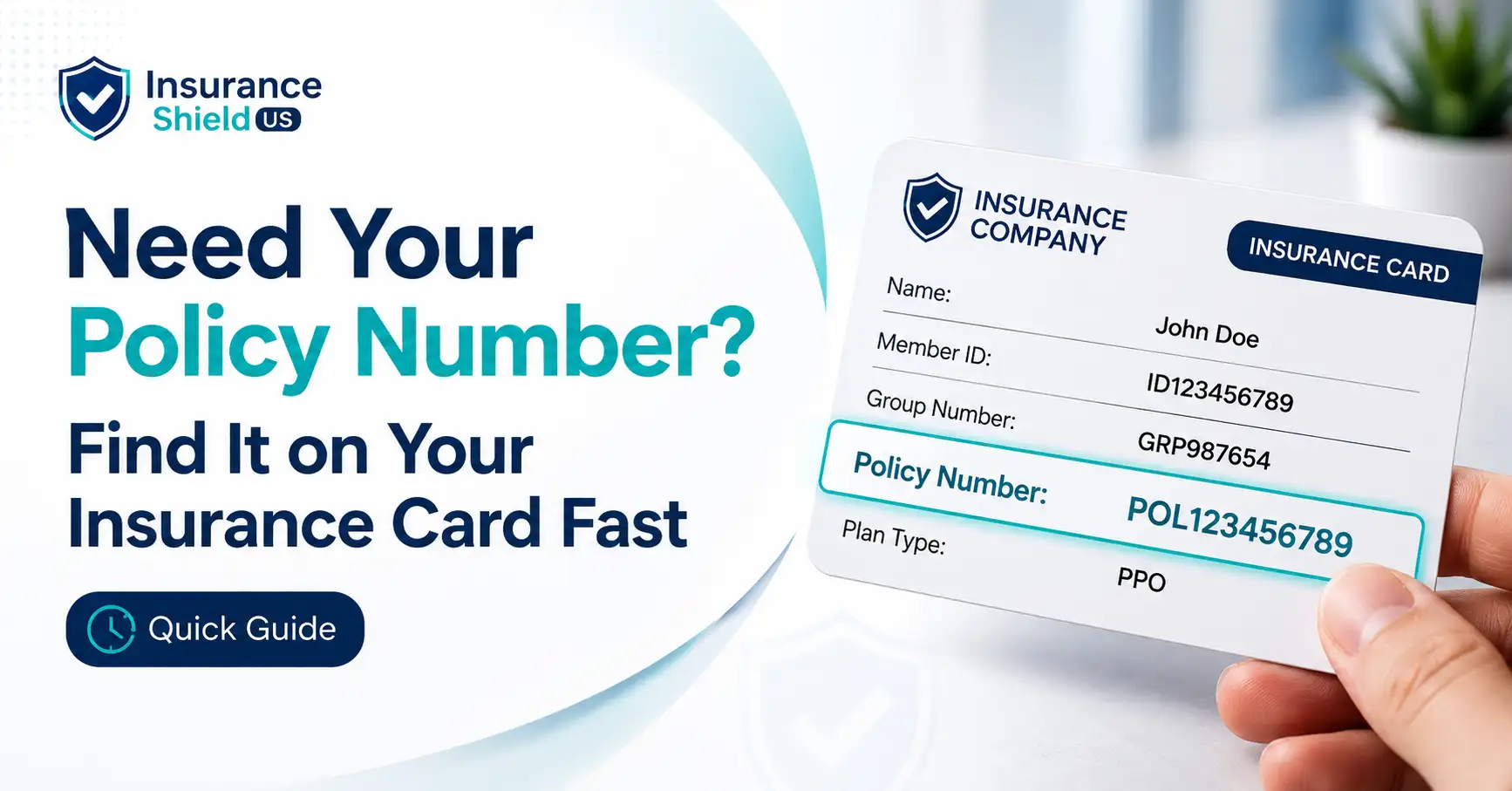
You are standing at a repair shop, doctor’s office, pharmacy, or accident scene when someone asks for your insurance policy number.
You pull out your insurance card and see several strings of letters and numbers: a member ID, group number, plan number, vehicle identification number, and perhaps an insurer code.
Which one is the policy number?
The answer is usually simple once you know what label to look for. The confusing part is that insurance companies do not all use the same card design, and health insurance cards often use a different name for the number that identifies your coverage.
Quick Answer: On an auto insurance card, the policy number is usually near the top and labeled “Policy Number,” “Policy No.,” or “Policy #.” On a health insurance card, the number you need may instead be labeled “Member ID,” “Subscriber ID,” or “Identification Number.” If you cannot find it, check your declarations page, insurer’s mobile app, billing statement, or call the customer-service number printed on the card.
What Does an Insurance Policy Number Look Like?
An insurance policy number is a unique combination of letters, numbers, or both that an insurance company uses to identify a specific policy.
It may look like:
- 123456789
- AUTO-4589217
- H0M12345678
- ABC-92-347891
- 987654321-01
There is no universal format. One company may use nine numbers, while another may include letters, hyphens, spaces, or a suffix.
Do not assume that the longest number on the card must be the policy number. A vehicle identification number, member ID, or group number may be longer.
The safest method is to look for the label next to the number.
Where Is the Policy Number on an Auto Insurance Card?
On an auto insurance card, the policy number is commonly printed near the top, often close to the name of the insurance company and the named policyholder.
Look for one of these labels:
- Policy Number
- Policy No.
- Policy #
- Policy ID
The card may also show:
- Name of the insured driver
- Insurance company name
- Policy effective date
- Policy expiration date
- Insured vehicle
- Vehicle identification number
- Year, make, and model
- Agent or insurer phone number
- Insurer identification or NAIC number
The National Association of Insurance Commissioners explains that an auto policy’s declarations page identifies the policy number, policy term, covered vehicles, coverage limits, and insured person.
A Simple Auto Insurance Card Example
Imagine your card shows:
Named insured: Sarah Johnson
Policy No.: AXY-48201935
Effective date: January 1, 2026
Expiration date: July 1, 2026
Vehicle: 2022 Toyota Camry
VIN: 4T1G11AK9NU123456
In this example, AXY-48201935 is the policy number.
The 17-character number beginning with “4T1” is the vehicle identification number, commonly called the VIN. It identifies the car—not the insurance contract.
Is the Policy Number the Same as the NAIC Number?
No.
An NAIC number identifies the insurance company, while the policy number identifies your individual insurance policy.
An auto insurance card may display both. The NAIC number is often five digits and may appear near the insurer’s name or at the bottom of the card.
For example:
- Policy number: AUTO-8271649
- NAIC number: 12345
If a police officer, repair shop, lender, or claims representative asks for your policy number, do not give the NAIC number unless they specifically request it.
Where Is the Policy Number on a Health Insurance Card?
Health insurance cards can be more confusing because many do not use the words “policy number.”
Instead, the number used to identify your coverage may be labeled:
- Member ID
- Subscriber ID
- Identification Number
- Member Number
- Enrollee ID
- ID Number
The Centers for Medicare & Medicaid Services explains that the member number identifies the covered individual and tells the medical provider how to bill the health plan. CMS separately describes the group number as the number used to identify the specific benefits offered by the plan.
Therefore, when a doctor’s office asks for your “health insurance policy number,” it may actually want the member or subscriber ID printed on the card.
A Simple Health Insurance Card Example
Your health card might show:
Member: David Miller
Member ID: XYZ45892011
Group No.: 771204
Plan: Gold PPO
Rx BIN: 610014
Rx Group: RX9921
In this example:
- XYZ45892011 is the member ID used to identify the insured person.
- 771204 is the group number connected to the employer or benefits package.
- 610014 is an electronic pharmacy-routing number.
- RX9921 identifies the prescription-drug group.
A doctor’s office may ask for both the member ID and group number. That does not mean they are the same.
What Is the Difference Between a Member ID and a Group Number?
A member ID identifies the individual covered by the health plan.
A group number usually identifies the employer, organization, or benefits arrangement under which the person receives coverage.
For example, two employees working for the same company may have:
- The same group number
- Different member ID numbers
A spouse or child may also have a slightly different member ID, although some plans place family members under one subscriber number with different suffixes.
CMS educational material shows health cards containing both a member ID and a group number because each serves a different purpose.
When completing a medical form, enter each number in the field that matches its label.
Is a Marketplace Plan ID the Same as Your Policy Number?
No.
HealthCare.gov explains that each Marketplace plan has a unique 14-character Plan ID. This identifies the insurance product offered through the Marketplace, not necessarily the individual enrolled member.
Your Marketplace paperwork may contain:
- Application ID
- Plan ID
- Member ID
- Subscriber ID
- Group number
- Insurance company account number
These numbers serve different purposes.
When a medical provider asks for your insurance information, the member or subscriber ID on the insurer-issued card is usually more useful than your Marketplace application number.
Where Is the Policy Number on a Homeowners or Renters Insurance Card?
Homeowners and renters insurance companies do not always issue a wallet-sized insurance card.
You are more likely to find the policy number on:
- The declarations page
- Policy renewal notice
- Billing statement
- Insurer’s mobile app
- Online customer portal
- Proof-of-insurance document
- Mortgage insurance correspondence
- Email from your insurer or agent
The declarations page is usually one of the first pages of the policy. It summarizes key information such as the insured property, policy dates, limits, premium, deductibles, and policy number.
The NAIC confirms that a homeowners or renters declarations page identifies the policy number, effective dates, insured property, mortgage holder, coverage limits, premium, and discounts.
If you are gathering records before a loss or claim, the Insurance Document Checklist Generator can help you organize your policy number, declarations page, photos, receipts, estimates, and insurer correspondence.
Where Is the Policy Number on a Life Insurance Policy?
Life insurance companies commonly print the policy number on:
- The policy cover page
- Policy schedule
- Annual statement
- Premium notice
- Online account
- Insurer correspondence
- Beneficiary confirmation
- Automatic payment record
A life insurance policy number may not appear on a regular wallet card because many insurers do not issue one.
If a family member cannot find the original policy, search financial records, bank statements, email accounts, safe-deposit boxes, filing cabinets, and correspondence from insurance companies.
Contacting the insurer directly may also help, but the company may require identity verification and proof that the caller is the policy owner, insured person, beneficiary, or authorized representative.
How Can You Find the Policy Number Step by Step?
Step 1: Identify the Type of Insurance
Start by determining whether the card is for:
- Auto insurance
- Health insurance
- Dental insurance
- Vision insurance
- Prescription coverage
- Travel insurance
- Homeowners insurance
- Renters insurance
- Life insurance
The location and label of the identifying number can vary by insurance type.
Step 2: Look for the Most Direct Label
Search the front and back of the card for:
- Policy Number
- Policy No.
- Policy #
- Member ID
- Subscriber ID
- Identification Number
- Certificate Number
Do not choose a number based only on its length.
Step 3: Check the Effective Dates
Make sure you are looking at a current card.
An expired insurance card may show a valid-looking policy number even though the policy period has ended or the insurer has issued a replacement policy.
Look for:
- Effective date
- Expiration date
- Policy period
- Coverage dates
If you are reviewing your policy before it renews, the Insurance Renewal Checklist Generator can help you check policy dates, premium changes, deductibles, exclusions, and updated documents.
Step 4: Compare the Card With Your Policy Documents
Check the number against:
- Declarations page
- Welcome letter
- Billing notice
- Renewal statement
- Insurance binder
- Digital policy
- Previous insurer email
The same policy number should generally appear across multiple official documents, although spacing or punctuation may be displayed differently.
For example, the card may show ABC1234567, while the billing statement shows ABC-123-4567.
Step 5: Log In to the Insurer’s Website or App
Most insurers provide digital access to policy documents.
After logging in, look under sections such as:
- My Policies
- Coverage
- ID Cards
- Policy Documents
- Account Details
- Proof of Insurance
- Membership Information
Download the current card rather than relying on an old screenshot saved on your phone.
Step 6: Call the Number on the Card
If you are still unsure, call customer service or member services.
Before providing personal information, make sure you are using the official number printed on the card, policy document, or insurer’s verified website.
The company may ask for:
- Your name
- Date of birth
- Address
- Vehicle information
- Last four digits of your Social Security number
- Email address
- Employer name
- Other identity-verification information
Do not share sensitive information with an unsolicited caller claiming to represent your insurer. The NAIC recommends verifying the organization before disclosing personal or financial information.
What If There Is No Number Labeled “Policy Number”?
This is common with health insurance.
Look for a Member ID or Subscriber ID first. When calling a doctor, pharmacy, or health insurer, explain exactly which labels appear on the card.
You can say:
“My card does not show a policy number. It has a member ID and group number. Which one do you need?”
For auto insurance, a card without a clearly labeled policy number may be a temporary binder, digital proof-of-insurance screen, or incomplete document.
Check the declarations page or call the insurer before assuming that another number is the policy number.
What If You Lost Your Insurance Card?
Losing the physical card does not automatically mean you lost coverage.
Try these options:
- Log in to the insurer’s website.
- Open the insurer’s mobile app.
- Search your email for the company name and “ID card.”
- Check your policy declarations or renewal documents.
- Contact your agent.
- Call customer service.
- Request a replacement card.
HealthCare.gov states that after enrollment, the health plan sends the member an insurance card that serves as proof of coverage.
For auto insurance, many states accept electronic proof of insurance, but requirements vary. Triple-I notes that states commonly require drivers to carry valid proof of insurance and provide it after a traffic stop or accident.
Check your state Department of Motor Vehicles or Department of Insurance for local rules.
Is the Policy Number the Same as a Claim Number?
No.
The policy number identifies the insurance contract.
The claim number identifies a particular reported loss or request for benefits.
For example:
- Policy number: AUTO-1837462
- Claim number: CLM-2026-004891
One policy can have several different claim numbers over time.
If an adjuster asks for your claim number, giving only the policy number may slow down the conversation because the representative must search for the specific loss.
When preparing to report damage, use the Claim Denial Risk Checker to review common issues involving policy status, missing records, deadlines, exclusions, and inaccurate claim details.
Is the Policy Number the Same as an Account Number?
Not always.
An insurer may assign a separate billing or online account number.
A household with several policies could have:
- One customer account number
- One auto policy number
- One homeowners policy number
- One umbrella policy number
Always copy the number from the field specifically labeled for the policy you are discussing.
Should You Share Your Policy Number With Someone Else?
A policy number is not usually treated like a Social Security number, but it should still be handled carefully.
It is reasonable to provide it to:
- Your insurer
- Insurance agent
- Doctor or pharmacy
- Repair shop working on a claim
- Police officer after an accident
- Another driver after a collision
- Mortgage lender
- Authorized attorney
- Licensed claims professional
Be cautious when someone unexpectedly asks for the number by phone, text, email, or social media.
Verify who they are, why they need it, and whether you initiated the contact.
Avoid posting a clear photo of your full insurance card publicly. It may expose your name, address, policy number, vehicle information, member ID, and customer-service details.
What Common Mistakes Should You Avoid?
Giving the VIN Instead of the Auto Policy Number
A VIN usually contains 17 characters and identifies a specific vehicle.
Look for “Policy Number” rather than selecting the longest number on the card.
Giving the Group Number Instead of the Health Member ID
The group number identifies the plan arrangement, while the member ID identifies the covered person.
A provider may need both, so enter them in the correct fields.
Using an Expired Insurance Card
The policy may have renewed with a new number, insurer, vehicle, member ID, or coverage period.
Check the dates before sharing the information.
Confusing a Claim Number With a Policy Number
The policy number identifies the coverage contract. The claim number identifies one reported event.
Keep both in your claim file.
Reading the Insurer’s NAIC Number as the Policy Number
The NAIC number identifies the insurance company, not your individual policy.
Using the Marketplace Application ID at the Doctor’s Office
A HealthCare.gov Application ID helps locate a Marketplace application. It is different from the member ID issued by the health insurance company.
Sending a Full Insurance Card to an Unverified Person
Confirm the recipient before sending a photo or scan. Cover unrelated personal information when appropriate.
Keeping Only One Copy
Store the number in more than one secure place, such as the insurer’s app, a password-protected digital folder, and your policy records.
What Other Information Should You Check While Looking at the Card?
Finding the policy number is useful, but take a moment to review the rest of the document.
Check:
- Correct name and address
- Current effective dates
- Covered vehicle or property
- Correct family members
- Insurance company name
- Customer-service number
- Claims phone number
- Deductible information
- Copay amounts
- Prescription details
- Agent contact information
A current card does not prove that every possible loss or service is covered. The full policy explains coverage limits, exclusions, deductibles, and conditions.
You can use the Insurance Coverage Gap Checker to prepare questions about outdated information, missing protection, exclusions, policy changes, and major life events.
For a complete collection of educational checklists and calculators, visit the Free Insurance Tools Hub.
A Simple Policy Number Checklist
Before giving the number to anyone, confirm that:
- You identified the correct type of insurance.
- The card is current.
- The number is beside the correct label.
- You did not copy the VIN or NAIC number.
- You did not confuse the member ID with the group number.
- You did not use a claim number or account number.
- The name on the card matches the insured person.
- You verified who is requesting the information.
- You saved a secure copy for future use.
The Bottom Line
On an auto insurance card, the policy number is usually clearly labeled “Policy Number,” “Policy No.,” or “Policy #.”
On a health insurance card, the equivalent number may be labeled “Member ID,” “Subscriber ID,” or “Member Number.” The group number, plan ID, pharmacy numbers, VIN, NAIC number, account number, and claim number all serve different purposes.
When the card is unclear, do not guess. Check the declarations page, online account, insurer’s app, renewal notice, or call the official customer-service number.
Taking an extra minute to confirm the correct number can prevent billing problems, delayed claims, rejected forms, and unnecessary phone calls later.
Educational Disclaimer
This article is provided for general educational and informational purposes only. It is not insurance, legal, financial, medical, or policy-specific advice.
Insurance card formats, terminology, coverage rules, and documentation requirements vary by insurer, policy, employer, and state. Review your official policy documents and contact your insurance company, licensed insurance professional, health plan, employer benefits administrator, or state Department of Insurance for guidance about your specific coverage.

I’m Muhammad Waqas, the creator of Insurance Shield US. I write simple insurance guides, checklists, and tool-based content to help everyday readers understand coverage gaps, claim risks, policy documents, and renewal mistakes. My content is for educational purposes only and does not replace advice from a licensed insurance professional.