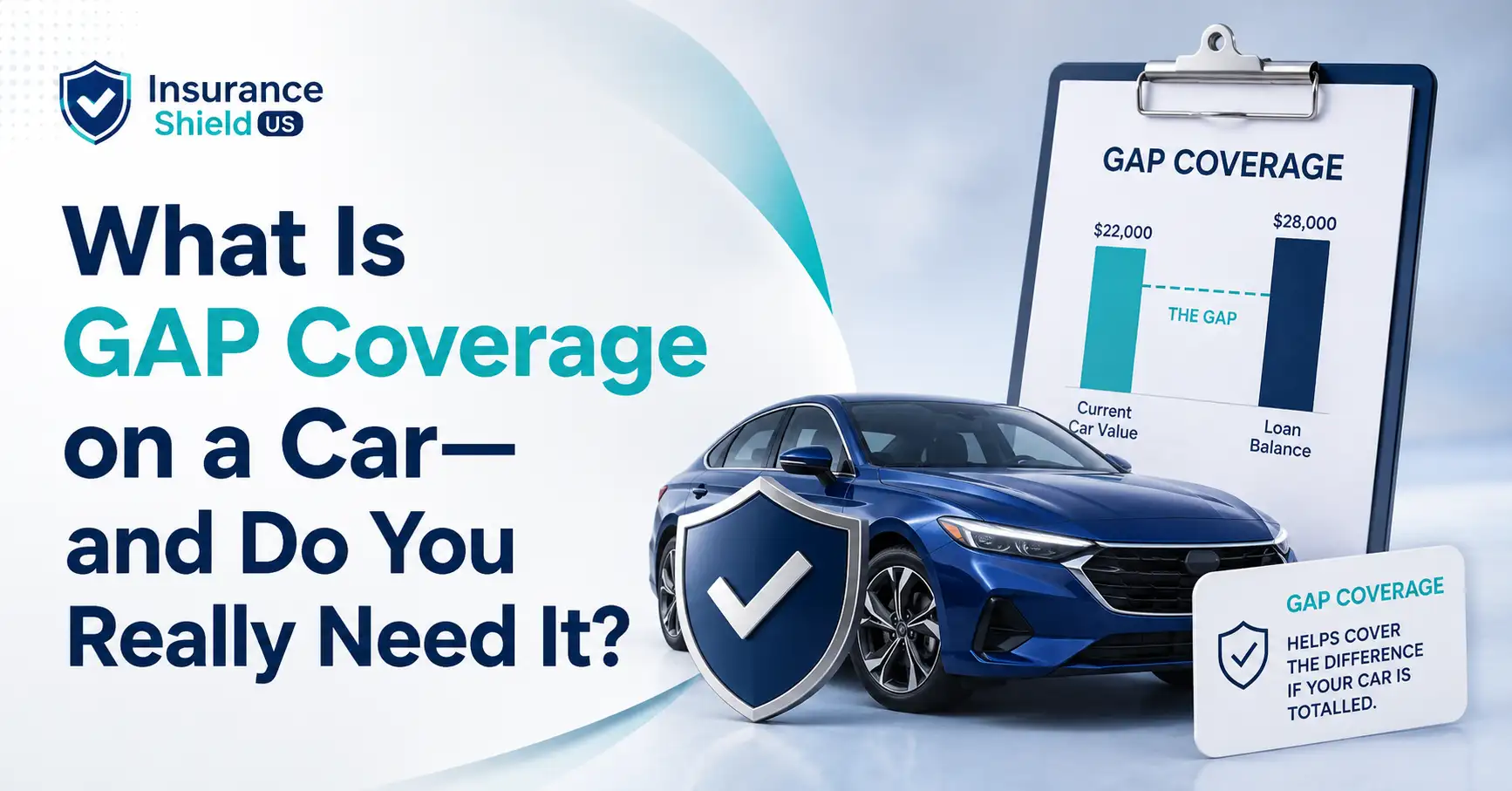
Imagine buying a car for $32,000 with a small down payment. Eight months later, the vehicle is totaled in an accident.
You check your loan account and discover that you still owe $28,000. Your auto insurance company, however, values the car at only $24,000.
Even after the insurance claim is paid, you could still owe thousands of dollars on a car you can no longer drive.
That uncomfortable difference is the problem GAP coverage is designed to address.
It can be useful protection for some financed or leased vehicles, but it is not automatically necessary for every driver. It also does not replace regular auto insurance or pay for every expense connected to a total loss.
Quick Answer: GAP coverage may pay some or all of the difference between what you owe on a financed or leased car and what your primary auto insurer pays if the vehicle is stolen or declared a total loss. It generally does not pay for ordinary repairs, missed payments, maintenance, or the cost of purchasing another vehicle. The exact protection depends on the GAP contract, provider, state rules, exclusions, and coverage limits.
What Does GAP Coverage Mean on a Car?
GAP commonly refers to Guaranteed Asset Protection or Guaranteed Auto Protection.
It is an optional product designed for situations in which your car is worth less than the remaining balance on your auto loan or lease.
This situation is often called being upside down or having negative equity.
For example:
- Remaining auto loan: $28,000
- Car’s actual cash value: $24,000
- Difference: $4,000
Without GAP protection, you may remain responsible for that $4,000 difference after your primary auto insurance claim is settled.
The Consumer Financial Protection Bureau describes GAP as an optional product intended to cover the difference between the amount owed on an auto loan and the amount paid by the insurance company when a vehicle is stolen or totaled.
The word “coverage” can be slightly confusing because GAP products do not always take the same legal form.
Depending on the provider and state, you may be offered:
- A GAP insurance policy
- An endorsement added to your auto insurance
- Loan or lease payoff coverage
- A debt-cancellation agreement
- A GAP waiver from the lender or dealership
A GAP waiver generally means the creditor agrees to waive some or all of the eligible remaining balance after a covered total loss. A GAP insurance policy may instead provide insurance benefits toward that balance.
The practical purpose is similar, but the contract structure, regulator, exclusions, claim process, and consumer protections may differ.
How Does GAP Coverage Work?
GAP coverage normally becomes relevant only after the primary auto insurance company determines that the vehicle is a total loss or confirms that it was stolen and not recovered.
The usual process looks like this:
- The vehicle is stolen or seriously damaged.
- A claim is filed under comprehensive or collision coverage.
- The primary insurer calculates the vehicle’s actual cash value.
- The applicable auto insurance deductible is subtracted.
- The primary claim payment is sent according to the policy and lender’s interest.
- The remaining eligible loan balance is calculated.
- A GAP claim or waiver request is submitted.
- The GAP provider reviews the remaining balance, exclusions, limits, and required records.
GAP does not usually decide how much the car was worth. That calculation is generally handled through the primary auto insurance claim.
It responds to the eligible difference left after that claim has been processed.
What Is Actual Cash Value?
Actual cash value is the approximate value of the vehicle immediately before the covered loss—not the amount you originally paid and not necessarily the amount you still owe.
The insurer may consider factors such as:
- The vehicle’s age
- Mileage
- Condition
- Trim level
- Factory-installed equipment
- Local prices for comparable vehicles
- Previous damage
- Depreciation
Cars generally lose value over time, but an auto loan balance may decline more slowly, especially during the early part of a long loan.
That is how a borrower can owe more than the vehicle is worth.
The National Association of Insurance Commissioners explains that ordinary auto coverage may not pay off an auto loan when the car’s market value is lower than the amount owed. GAP is intended to address that difference.
What Is a Simple Example of GAP Coverage?
Consider this realistic situation:
- Original vehicle price: $35,000
- Remaining loan balance: $30,000
- Actual cash value at the time of loss: $25,000
- Collision deductible: $1,000
The primary auto insurance calculation may begin like this:
$25,000 actual cash value − $1,000 deductible = $24,000
If the borrower still owes $30,000, the apparent shortage is $6,000.
A GAP product may pay some or all of the eligible shortage, depending on whether the contract covers the deductible and whether any part of the loan balance consists of excluded charges.
For example, the balance may include:
- A previous vehicle’s negative equity
- An extended warranty
- Late fees
- Missed payments
- Loan interest
- Dealer add-ons
- Service contracts
- Credit insurance
Some GAP agreements exclude one or more of these amounts.
That means you should never assume that the GAP payment will equal the simple difference between the insurer’s check and the number shown on your loan account.
Washington State’s Office of the Insurance Commissioner specifically warns that GAP may not cover interest, late fees, missed payments, or extended warranties added to an auto loan.
Does GAP Coverage Pay Your Auto Insurance Deductible?
Sometimes—but not always.
Some GAP contracts include all or part of the comprehensive or collision deductible. Others specifically exclude it or limit how much deductible assistance is available.
Using the previous example, the car’s actual cash value was $25,000, but the primary claim paid only $24,000 because of a $1,000 deductible.
One GAP product might include that $1,000 in its calculation. Another may leave the borrower responsible for it.
Read the section covering:
- Primary insurance deductible
- Maximum deductible benefit
- Unpaid deductible
- Deductible exclusions
- Claim settlement calculation
Do not confuse your GAP product with your regular auto insurance deductible. They are connected during a total-loss calculation, but they come from different contracts.
For a general explanation of how deductible choices affect insurance costs, use the Deductible vs Premium Calculator. The calculator is educational and cannot determine how a specific GAP contract will treat your deductible.
What Does GAP Coverage Usually Cover?
Subject to the actual agreement, GAP coverage is generally intended for an eligible difference between:
- The amount owed on a qualifying auto loan or lease
- The amount paid or recognized by the primary auto insurer after a covered total loss
It may apply when the insured car is:
- Declared a total loss after a covered collision
- Stolen and not recovered
- Declared a total loss after another covered event, such as fire or severe weather
The primary auto insurance policy must usually respond first.
For example, collision coverage may apply after a serious crash, while comprehensive coverage may apply to theft, fire, flooding, falling objects, or certain weather damage.
GAP is not a substitute for those coverages. It addresses the qualifying loan or lease shortage left afterward.
What Does GAP Coverage Usually Not Cover?
The exclusions vary, but GAP coverage generally is not designed to pay for:
- Routine vehicle repairs
- Mechanical breakdowns
- Maintenance
- Tires or worn parts
- A down payment on a replacement vehicle
- Rental-car expenses
- Medical bills
- Bodily injury
- Damage you cause to another person’s property
- Missed monthly payments
- Late fees
- Loan penalties
- Regular depreciation when no total loss occurred
- A vehicle that can still be repaired
- A voluntary repossession
- A trade-in loss
- Reduced resale value after an accident
It may also exclude or limit:
- Negative equity rolled in from an old vehicle
- Extended warranties
- Service contracts
- Dealer-installed products
- Amounts above a percentage of the car’s original value
- Excessively long loan terms
- Balloon-payment loans
- Vehicles used for commercial purposes
- Claims denied by the primary auto insurer
- Losses involving prohibited or excluded vehicle use
Some GAP waivers place a maximum on the percentage of the vehicle’s original value that can be covered. New York regulatory materials, for example, recognize that GAP agreements may contain limits tied to a percentage of the vehicle’s value and exclusions involving certain loan structures or vehicle uses.
Always read the contract instead of relying on a salesperson’s summary.
Is GAP Coverage the Same as Full-Coverage Auto Insurance?
No.
“Full coverage” is not a standardized policy name. People often use the phrase to describe a combination of liability, collision, and comprehensive coverage.
Those coverages serve different purposes:
- Liability coverage may pay for injuries or property damage you cause to others.
- Collision coverage may pay for covered damage to your car caused by a collision.
- Comprehensive coverage may pay for covered losses such as theft, fire, weather damage, vandalism, or falling objects.
- GAP coverage may address an eligible difference between the vehicle’s value and the remaining loan or lease balance after a total loss.
A driver can have collision and comprehensive insurance but still owe money after a total loss.
The insurer generally pays according to the vehicle’s value and policy terms—not according to how much the borrower owes the lender.
Who May Benefit Most From GAP Coverage?
GAP protection may deserve consideration when there is a realistic chance that the vehicle will be worth less than the loan balance.
That may happen when you:
Make a Small Down Payment
A large portion of the vehicle was financed, so the loan balance may initially remain close to the purchase price.
Finance the Car for a Long Term
Loans lasting 72 or 84 months can reduce the monthly payment, but the balance may decline slowly.
Roll Negative Equity Into the New Loan
Suppose you owed $5,000 more on your old vehicle than its trade-in value. If that amount is added to the new loan, you may begin the new purchase already owing substantially more than the new car is worth.
Not every GAP product covers the full amount of rolled-in negative equity.
Buy a Vehicle That Depreciates Quickly
Some new vehicles lose value faster than the loan principal declines.
Finance Taxes, Fees and Add-On Products
Sales tax, registration charges, service contracts, warranties, accessories, and other add-ons can increase the amount financed without increasing the car’s actual cash value by the same amount.
Lease a Vehicle
A lease may already include GAP protection or a GAP waiver, but you should verify this in the lease agreement rather than assuming it is included.
Drive a Large Number of Miles
High mileage may reduce a vehicle’s market value more quickly, potentially increasing the difference between value and loan balance.
Who May Not Need GAP Coverage?
GAP may provide little value when you owe less than the vehicle’s current value.
It may be unnecessary when you:
- Paid cash for the car
- Made a large down payment
- Have a small remaining loan balance
- Paid the loan off
- Bought a used vehicle with substantial equity
- Already have equivalent loan or lease payoff coverage
- Have GAP included in the lease
- Could comfortably pay a possible loan shortage yourself
A quick way to review your position is:
Current loan payoff amount − approximate current vehicle value = possible exposure
Suppose:
- Loan payoff: $18,000
- Approximate car value: $21,000
You have approximately $3,000 in positive equity based on those estimates. GAP would not ordinarily have a shortage to cover at that moment.
Vehicle values and loan balances change, so review them periodically rather than making the decision only once.
You can use the Insurance Coverage Gap Checker to identify broader questions about missing protection, policy changes, major purchases, exclusions, and outdated coverage. It does not value your vehicle or confirm whether you need a particular GAP product.
Is GAP Coverage Required When Financing a Car?
GAP is generally optional.
The Consumer Financial Protection Bureau states that consumers generally cannot be required to purchase GAP insurance, an extended warranty, or credit insurance from a lender or dealer to obtain an auto loan.
However, a lease agreement may include GAP protection or require certain protections as part of the lease terms. State rules and contract structures also vary.
If a dealer says GAP is required, ask:
- Is this requirement written in the lender’s approval?
- Where is it stated in the loan or lease agreement?
- Is the product optional?
- Can I purchase similar coverage elsewhere?
- What would my payment be without it?
- Is the GAP price being added to the loan?
- Will I pay interest on the financed GAP charge?
Do not rely only on a verbal explanation.
Review the itemized purchase agreement before signing. Optional products should be clearly identified rather than quietly added to the financed amount.
Where Can You Buy GAP Coverage?
Depending on availability and state rules, GAP may be offered by:
- An auto insurance company
- An insurance agent or broker
- A dealership
- A bank
- A credit union
- An auto lender
- A leasing company
The price, limits, cancellation terms, claim procedures, and legal structure may differ significantly.
An insurer may offer GAP as an endorsement connected to your auto policy. A dealership or lender may offer a GAP waiver or another debt-cancellation product and add its cost to the auto loan.
The CFPB advises consumers who choose GAP to shop around because lenders may charge different prices.
Before buying, compare:
- Total price
- Whether the charge is financed
- Interest added over the loan term
- Coverage duration
- Maximum benefit
- Deductible treatment
- Negative-equity treatment
- Excluded add-ons
- Cancellation rules
- Refund rules
- Claim deadlines
- Required documents
What Happens When GAP Is Added to the Auto Loan?
Suppose the dealership charges $900 for a GAP product and adds it to a six-year auto loan.
You may not pay only $900.
Because the cost is financed, interest may also be charged on that amount over the life of the loan. Your monthly payment may increase only slightly, which can make the total cost easy to overlook.
Ask the dealer or lender to show:
- The GAP price by itself
- The monthly payment without GAP
- The monthly payment with GAP
- The total amount financed
- The total finance charge
- The overall cost if the loan runs to maturity
This helps you compare the dealership product with coverage available through an insurer, bank, or credit union.
Can You Cancel GAP Coverage After Buying It?
Cancellation rights depend on the contract and applicable state law.
Some agreements provide a free-look period during which the product can be canceled for a full refund. Later cancellation may result in a prorated refund.
A refund may also be available in certain cases when:
- The loan is paid off early
- The vehicle is refinanced
- The vehicle is sold or traded
- The GAP product is canceled
- The financed vehicle is no longer eligible
Do not assume the refund will happen automatically.
Read the cancellation section and ask:
- Who receives the cancellation request?
- Is a written form required?
- What documents must be submitted?
- Is there a cancellation fee?
- Is the refund full or prorated?
- Will the refund go to me or the lender?
- Will it reduce the loan principal?
- How long does processing take?
Keep the contract, cancellation request, payoff statement, proof of sale, and all related correspondence.
The Insurance Document Checklist Generator can help you organize policy documents, account information, receipts, photos, reports, and insurer communications before a claim or cancellation request.
How Do You File a GAP Claim?
The exact procedure varies, but these steps are commonly helpful.
Step 1: File the Primary Auto Insurance Claim
Report the theft or damage to your auto insurer promptly.
GAP generally does not replace the primary comprehensive or collision claim.
Step 2: Confirm That the Vehicle Is a Total Loss
Ask for the written total-loss determination and valuation report.
Review the vehicle description, mileage, trim, options, condition adjustments, and comparable vehicles used in the valuation.
Step 3: Obtain the Loan Payoff Statement
Request a payoff statement showing the balance as of the loss or settlement date required by the GAP agreement.
The online account balance may not be the same as the official payoff amount.
Step 4: Contact the GAP Administrator
The company selling the product may not be the company administering the claim.
Check the contract for:
- Administrator name
- Claim telephone number
- Claim website
- Mailing address
- Filing deadline
- Required forms
Step 5: Submit the Required Documents
Commonly requested records may include:
- GAP contract
- Auto insurance declarations page
- Primary insurer’s settlement statement
- Total-loss valuation
- Police report
- Loan agreement
- Buyer’s order
- Payment history
- Official payoff statement
- Proof of deductible
- Vehicle registration
- Driver’s license
- Theft documentation
- Cancellation records for refundable add-ons
Requirements vary, so follow the administrator’s written checklist.
Step 6: Continue Monitoring the Loan
Do not assume that filing a GAP claim freezes the loan or stops all payment obligations.
Ask the lender what payments remain due while the claim is being processed. A delayed or incomplete GAP claim can create late fees or credit problems if the borrower simply stops communicating.
Step 7: Get the Final Calculation in Writing
Ask the administrator to show:
- Primary insurance payment
- Loan balance used
- Deductible treatment
- Excluded charges
- Canceled-product refunds
- GAP benefit
- Remaining borrower responsibility
If the result leaves a balance, request a written explanation of why each amount was excluded.
Before submitting, use the Insurance Claim Denial Risk Checker to review common issues involving missing documents, policy dates, exclusions, deadlines, payment status, and inconsistent claim information.
You can also read Why Do Insurance Claims Get Denied? for a broader explanation of claim documentation and policy problems that may delay or complicate an insurance claim.
What Common GAP Coverage Mistakes Should You Avoid?
Assuming GAP Buys You a New Car
GAP is generally intended to address an eligible loan or lease shortage. It does not usually provide a down payment for another vehicle.
Believing GAP Covers Ordinary Repairs
A damaged car that can be repaired does not normally create a GAP claim.
The primary collision or comprehensive coverage handles eligible repair costs.
Buying GAP Without Checking Existing Coverage
Your lease, auto insurer, lender, or credit union may already provide similar protection.
Paying twice does not necessarily produce two full benefits.
Focusing Only on the Monthly Payment
A GAP product can look inexpensive when spread over a long loan, but financing it may add interest.
Compare the total cost.
Assuming Every Dollar of the Loan Is Covered
Late fees, warranties, service contracts, missed payments, interest, and old negative equity may be excluded.
Read the benefit calculation carefully.
Confusing GAP With New-Car Replacement Coverage
New-car replacement coverage may help replace a totaled newer vehicle under qualifying policy terms. GAP focuses on the difference between eligible debt and the primary insurance settlement.
They solve different problems.
Canceling Auto Insurance Because You Bought GAP
GAP does not replace liability, collision, or comprehensive insurance.
In most cases, there must first be an eligible primary auto insurance settlement.
Missing the Filing Deadline
Some GAP agreements require documents within a particular period.
Notify the administrator promptly and keep proof of every submission.
Throwing Away Purchase and Loan Documents
The original buyer’s order and finance agreement can show which products were added to the loan.
Store them with the GAP contract and auto insurance records.
Keeping GAP After It No Longer Provides Value
Once the loan balance falls below the vehicle’s value, the risk GAP was designed to cover may be gone.
Review cancellation and refund options rather than paying for unnecessary protection.
How Can You Decide Whether GAP Coverage Is Worth It?
Use this simple process before buying.
1. Find the Total Loan Payoff Amount
Ask the lender for the current payoff figure—not just the next payment or principal balance shown online.
2. Estimate the Vehicle’s Current Value
Review several reliable vehicle-value sources and local comparable listings. Remember that the insurer’s final total-loss value could be different.
3. Calculate the Approximate Difference
Subtract the estimated vehicle value from the loan payoff.
A large positive result means you may have negative equity.
4. Review Your Existing Protection
Check your:
- Auto policy
- Lease agreement
- Loan agreement
- Dealer paperwork
- Credit-union benefits
Look for GAP, loan/lease payoff coverage, debt cancellation, or total-loss protection.
5. Compare Multiple Offers
Compare the total cost, not only the monthly amount.
6. Read the Exclusions
Pay close attention to deductibles, negative equity, financed products, late payments, loan limits, and cancellation terms.
7. Review the Need Each Year
The loan balance and car value will change.
Add GAP coverage to your annual auto insurance review using the Insurance Renewal Checklist Generator. It can help you remember to review premiums, deductibles, limits, exclusions, policy documents, claim history, and major financial changes before renewing.
What Questions Should You Ask Before Buying GAP?
Take these questions to the dealer, lender, credit union, agent, or insurer:
- Is this product optional?
- Is it GAP insurance, a GAP waiver, or debt cancellation?
- Who provides and administers it?
- What is the total price?
- Will the cost be added to my loan?
- How much interest will I pay on it?
- Does it cover my auto insurance deductible?
- Does it cover negative equity from my trade-in?
- Are warranties and service contracts excluded?
- Is there a maximum benefit?
- Are there loan-to-value or term limits?
- What events qualify as a covered total loss?
- What happens if the primary auto claim is denied?
- What documents are needed for a claim?
- What is the claim-filing deadline?
- Can I cancel the product?
- Can I receive a refund after early payoff or sale?
- Is similar protection already included in my lease or auto policy?
Get the answers in writing.
A salesperson’s verbal explanation will not replace the terms of the signed GAP agreement.
For additional educational tools covering policy gaps, deductibles, renewals, documents, and claim preparation, visit the Free Insurance Tools Hub.
The Bottom Line
GAP coverage is designed for one specific financial problem: owing more on a financed or leased car than the vehicle is worth when it is stolen or declared a total loss.
It can be valuable when you make a small down payment, use a long loan term, roll old debt into a new loan, or finance a vehicle that may depreciate quickly.
It may be unnecessary when you have strong equity, a small loan balance, an existing GAP benefit, or enough savings to handle the possible difference yourself.
Before buying, compare the loan payoff with the car’s estimated value. Check whether similar protection is already included, ask for the total price, and read the exclusions closely.
Most importantly, do not assume GAP pays every dollar connected to your auto loan. The benefit depends on the contract’s definition of the covered balance, its deductible rules, exclusions, limits, and claim requirements.
Educational Disclaimer
This article is provided for general educational and informational purposes only. It is not insurance, legal, financial, lending, tax, or policy-specific advice.
GAP products, auto insurance coverage, exclusions, limits, refunds, deductibles, and consumer protections vary by provider, contract, lender, and state. Review your actual policy, loan, lease, and GAP agreement, and consult a licensed insurance professional, lender, attorney, financial professional, or state Department of Insurance regarding your individual situation.

I’m Muhammad Waqas, the creator of Insurance Shield US. I write simple insurance guides, checklists, and tool-based content to help everyday readers understand coverage gaps, claim risks, policy documents, and renewal mistakes. My content is for educational purposes only and does not replace advice from a licensed insurance professional.