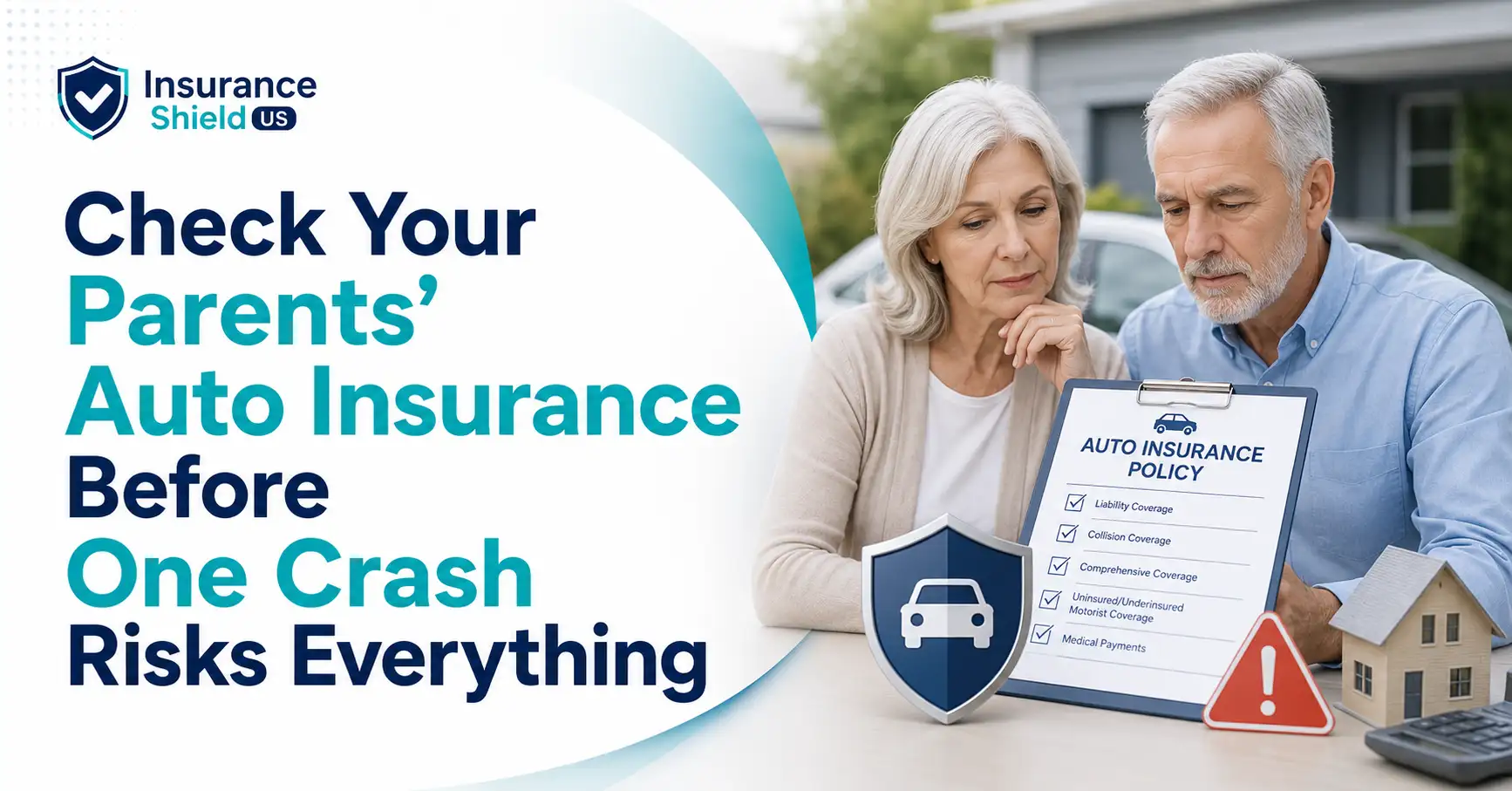
Your parents may have driven safely for decades. They renew their auto insurance every year, pay the bill on time, and keep the insurance card in the glove box.
Everything appears responsible.
Then one ordinary mistake causes a chain-reaction crash. Three vehicles are damaged, several people need medical care, and your parents discover that their policy carries only the minimum liability coverage required by their state.
That minimum may have been enough to keep the car legally registered. It may not be enough to cover the actual damage.
The difference can become a personal financial problem involving savings, income, legal expenses, and potentially other assets. Exactly what can be collected after a judgment depends on state law, ownership, exemptions, and the facts of the case—but families should never assume that a home, retirement plan, or expected inheritance is automatically protected.
You may not be able to settle every disagreement about whether an aging parent should continue driving. You can still help them check whether their insurance is prepared for the financial consequences of a serious accident.
Quick Answer: Ask your parents to show you the declarations page of their auto policy and check their bodily injury liability, property damage liability, uninsured motorist coverage, deductibles, listed drivers, vehicle use, and any umbrella policy. State-minimum coverage is only the legal floor and may be far below the cost of a multi-vehicle accident. Review the policy with a licensed insurance professional before changing coverage, and do not assume that a house or other assets are automatically safe from a lawsuit.
Why Is State-Minimum Auto Insurance Often Not Enough?
Every state sets its own auto insurance requirements. These requirements are designed to establish a minimum level of financial responsibility, not to guarantee that every possible accident will be fully paid.
The Insurance Information Institute warns that drivers may need more liability insurance than their state requires because accident costs can exceed minimum limits. When a person is legally responsible for damages beyond the amount the policy pays, the remaining amount may become their personal responsibility.
The National Association of Insurance Commissioners makes the same basic distinction: bodily injury liability helps respond to claims from people injured in an accident caused by the insured driver, while property damage liability pays for damage caused to vehicles and other property. Both forms of liability coverage are required in most states, but the required limits vary.
Minimum insurance may work for a minor parking-lot accident. It can become inadequate very quickly when an accident involves:
- Several vehicles
- Multiple injured people
- Ambulance transportation
- Emergency-room treatment
- Surgery or rehabilitation
- Lost wages
- A newer or luxury vehicle
- Damage to a building, fence, utility pole, or other property
- A lawsuit alleging pain, disability, or long-term harm
The fact that a policy meets state law does not mean it matches the family’s real financial exposure.
What Do Numbers Like 25/50/25 Mean?
Auto liability limits are often displayed as three numbers.
A policy showing 25/50/25 generally means:
- Up to $25,000 for bodily injury to one person
- Up to $50,000 for bodily injury to everyone injured in one accident
- Up to $25,000 for property damage from one accident
These are policy maximums, not guaranteed payments. The insurer still applies the policy language, investigates responsibility, and evaluates the claim.
The second number is especially easy to misunderstand. A $50,000 per-accident limit does not provide $50,000 to every injured person. It is the maximum available for all covered bodily injury claims arising from that accident.
Some policies use a combined single limit instead of three separate limits. That means one total limit may apply across covered bodily injury and property damage claims. Ask the insurer to explain exactly how the policy is structured.
How Can One Multi-Car Accident Exceed Minimum Coverage?
Consider a simplified example.
An older driver fails to stop in time and pushes one vehicle into two others. No one is killed, but three people report injuries.
The resulting claims include:
- Driver A’s medical expenses and lost income: $40,000
- Driver B’s medical expenses: $30,000
- Passenger’s treatment and rehabilitation: $35,000
- Damage to three vehicles: $70,000
The total claimed bodily injury amount is $105,000, while the property damage is $70,000.
If the at-fault driver has 25/50/25 limits, the policy may provide no more than $25,000 for any one injured person, $50,000 for everyone’s bodily injuries combined, and $25,000 for all covered property damage.
That creates a possible difference of:
- $55,000 between the claimed bodily injury total and the bodily injury per-accident limit
- $45,000 between the property damage total and the property damage limit
Real claims are more complicated. Responsibility may be disputed, claimed amounts may be negotiated, and state negligence laws can affect the result.
The example simply shows why minimum coverage can be exhausted before every bill or demand has been addressed.
Can an Accident Lawsuit Put a Parent’s Home or Savings at Risk?
A liability policy has a maximum amount it will pay. It does not automatically erase the portion of a covered judgment or settlement that exceeds the policy limit.
Whether a claimant can collect from a house, bank account, wages, or other property depends on state law and the individual circumstances. States have different homestead exemptions, judgment-enforcement rules, asset protections, ownership arrangements, and bankruptcy laws.
Some assets may receive strong legal protection. Others may receive limited protection or no protection at all.
There are two mistakes families should avoid:
- Assuming that the family home can always be taken after an accident
- Assuming that the family home can never be touched
Both conclusions are too broad.
An adult child also should not treat a parent’s property as a guaranteed future inheritance. The asset belongs to the parent while the parent is alive and may be used, sold, transferred, spent, or affected by valid debts and judgments.
A licensed insurance professional can explain available coverage. An attorney in the parents’ state should answer questions about homestead protection, asset ownership, judgment collection, estate planning, or potential personal liability.
What Should You Check on Your Parents’ Auto Policy?
Start with the policy’s declarations page. This is the summary showing the insured drivers, vehicles, coverage types, limits, deductibles, policy period, and premium.
Do not rely only on the insurance card. The card usually confirms that coverage exists but does not show the full protection.
Use the Insurance Coverage Gap Checker to create a general list of limits, deductibles, exclusions, household changes, and policy details that may deserve attention before you speak with the insurer.
1. Bodily Injury Liability
Bodily injury liability generally responds when the insured driver is legally responsible for injuring another person.
It may apply to expenses or damages involving:
- Medical treatment
- Lost wages
- Rehabilitation
- Pain and suffering
- Legal defense
- Death-related claims
The exact protection depends on the policy and state law.
Look for both the per-person limit and the per-accident limit. A reasonable per-person number can still leave a serious gap if the total per-accident limit must be shared by several injured people.
2. Property Damage Liability
Property damage liability generally pays for covered damage the insured driver causes to someone else’s property.
That may include:
- Another car
- Several vehicles
- A fence
- A building
- A utility pole
- A road sign
- Landscaping
- Other physical property
The rising cost of vehicles and repairs makes this limit particularly important. One newer SUV, electric vehicle, or luxury car can be worth more than some state-minimum property damage limits.
A state insurance regulator may require a relatively low legal minimum while also encouraging consumers to consider higher limits. For example, Virginia’s official consumer guidance notes that drivers should consider higher property damage limits because of increased vehicle and repair costs.
3. Uninsured and Underinsured Motorist Coverage
Liability coverage protects against claims made by other people when your parent causes an accident.
Uninsured and underinsured motorist coverage protects your parent when the responsible driver has no insurance or not enough insurance.
Depending on the state and policy, it may help with injuries, lost income, or property damage caused by:
- An uninsured driver
- A driver with insufficient liability limits
- A hit-and-run driver
The NAIC describes uninsured motorist coverage as protection that may respond when the policyholder is injured or suffers property damage because of an uninsured or hit-and-run driver.
Do not reject this coverage automatically just because your parent has health insurance. Health insurance does not necessarily replace lost income, pain-and-suffering damages, vehicle damage, or every accident-related cost.
4. Medical Payments or Personal Injury Protection
Depending on the state, the policy may include medical payments coverage or personal injury protection, commonly called PIP.
These coverages may help with certain medical expenses for the insured driver and passengers, regardless of who caused the accident. PIP may also include additional benefits depending on state rules.
Ask:
- Who is covered?
- What is the limit?
- Is there a deductible?
- Does it coordinate with Medicare or other health insurance?
- Does it include lost-income or household-service benefits?
- Is it required, optional, or rejectable in the state?
Do not make assumptions based on another family member’s policy. Auto insurance rules differ significantly between states.
5. Collision and Comprehensive Coverage
Liability insurance pays for covered injury and property claims made by others. It does not normally pay to repair your parent’s own vehicle after an at-fault collision.
Collision coverage generally applies to damage to the insured vehicle caused by a collision with another vehicle or object.
Comprehensive coverage generally applies to non-collision losses such as theft, hail, fire, flooding, falling objects, vandalism, or an animal strike. The NAIC explains these two coverages in similar terms.
An older car may not need the same physical damage protection as a newer financed vehicle. However, dropping collision or comprehensive coverage means the family should be financially prepared to repair or replace the car without that protection.
6. Deductibles
Collision and comprehensive coverage usually have deductibles.
A $1,000 collision deductible means your parent may have to absorb the first $1,000 of a covered vehicle-damage claim. If the car has only modest value, a high deductible may significantly reduce the practical benefit of carrying collision coverage.
Ask:
- What is the collision deductible?
- What is the comprehensive deductible?
- Could the parent pay both after an emergency?
- Is glass damage handled differently?
- Does the car’s current value still justify the coverage?
The Deductible vs Premium Calculator can help illustrate the general trade-off between recurring premiums and higher out-of-pocket costs. It provides an educational estimate and cannot calculate the value of a specific auto policy.
7. Every Driver Who Regularly Uses the Vehicle
Check that the insurer has accurate information about everyone who regularly drives the car.
Possible problems include:
- A spouse who is not correctly listed
- An adult child who regularly borrows the vehicle
- A caregiver who transports the parent
- A grandchild living in the household
- A driver whose license status has changed
- Someone who has moved into or out of the home
Do not assume that “any licensed driver” is automatically covered in every situation. Policies may distinguish among named insureds, household residents, listed drivers, excluded drivers, permissive users, and regular operators.
Ask the insurer how each person should be shown on the policy.
8. Vehicle Location and Use
The policy should accurately reflect:
- Where the car is normally kept
- The parent’s current home address
- Estimated yearly mileage
- Commuting use
- Business use
- Delivery work
- Rideshare use
- Regular travel between different homes
- Seasonal relocation
Retirement may reduce mileage, but it can also change how and where the vehicle is used. A parent who now spends several months in another state should ask whether the garaging address and coverage remain accurate.
Providing incomplete or incorrect information can create pricing problems and may complicate a later claim.
Should Your Parents Consider an Umbrella Policy?
A personal umbrella policy provides additional liability protection above qualifying auto, homeowners, or renters liability limits.
It generally begins responding after the applicable underlying policy limit has been exhausted. An umbrella may also include certain liability protection not provided by the underlying policy, although exclusions and conditions still apply.
The NAIC says umbrella policies may cover liability and defense expenses that exceed the amount available under primary insurance.
Umbrella insurers normally require the customer to maintain specified underlying auto and home liability limits. The Insurance Information Institute notes that many insurers expect substantial underlying auto and homeowners liability coverage before issuing an umbrella policy.
Ask the agent:
- What underlying auto limits are required?
- Is the home or renters policy also required?
- Are all household drivers covered?
- Are any drivers or vehicles excluded?
- Does the policy cover a second home?
- Does it cover rental cars?
- Are business, delivery, or rideshare activities excluded?
- How are legal defense costs handled?
- What happens if the underlying auto limit falls below the required amount?
An umbrella policy must generally be in force before an accident. It cannot be purchased afterward to cover a loss that has already happened.
How Much Liability Coverage Should an Aging Parent Carry?
There is no single limit that is correct for every parent.
The decision may depend on:
- The state’s legal requirements
- Savings and investments
- Home ownership
- Income
- Retirement income
- Household drivers
- Driving frequency
- Vehicle use
- Risk tolerance
- Existing umbrella coverage
- The cost of available limits
Ask the insurer to quote several liability options rather than requesting only the cheapest policy.
For example, the family might compare:
- The current state minimum
- 50/100 limits
- 100/300 limits
- 250/500 limits
- Higher property damage limits
- A combined single limit
- The limits required for an umbrella policy
These figures are comparison examples, not universal recommendations. Availability, pricing, and appropriate limits depend on the insurer, state, and household.
The NAIC recommends evaluating liability limits based on the assets that need protection rather than choosing automatically from the minimum required by law.
How Can You Discuss Insurance Without Making Your Parent Feel Attacked?
The quickest way to end the conversation is to begin with, “You are too old to drive.”
Age alone does not determine whether someone is a safe driver. NHTSA notes that many older adults remain capable drivers, while changes in vision, physical fitness, reflexes, health, or memory may affect some people’s driving ability. Decisions should be based on actual abilities and risks, not age by itself.
Start with financial protection rather than driving privileges.
You might say:
“I’m not asking you to give up the car. I realized that state-minimum insurance may not cover a serious accident, and I’d feel better if we reviewed the policy together.”
Or:
“Can we check the liability numbers before the next renewal? I want to make sure one accident does not create a bigger financial problem than it needs to.”
This approach respects the parent’s independence while addressing a real risk.
NHTSA encourages families to discuss safe-driving plans before a crisis occurs. It also recognizes that older adults may fear that a family conversation is simply an attempt to take away their keys.
How Can You Review the Policy Step by Step?
Step 1: Ask for Permission
Do not secretly access your parent’s online insurance account or impersonate them.
Ask them to join the review. The insurer may require the named policyholder’s permission before discussing policy details with an adult child.
If a parent is unable to manage financial matters, consult an attorney about valid authority such as a power of attorney. Do not assume that being an adult child automatically gives you legal control over the policy.
Step 2: Collect the Documents
Gather:
- Current declarations page
- Full auto policy
- Renewal notice
- Insurance identification cards
- Endorsements
- Driver list
- Vehicle list
- Umbrella policy
- Recent bills
- Claim history
- Driver’s license information
- Vehicle registration
The Insurance Document Checklist Generator can help organize common policy, payment, vehicle, correspondence, and claim records before speaking with the insurer.
Step 3: Write Down the Current Limits
Create a simple list showing:
- Bodily injury per person
- Bodily injury per accident
- Property damage per accident
- Uninsured motorist limits
- Underinsured motorist limits
- PIP or medical payments
- Collision deductible
- Comprehensive deductible
- Rental reimbursement
- Roadside assistance
- Umbrella limit
Do not rely on memory.
Step 4: Identify What Has Changed
Ask whether any of the following happened since the last thorough review:
- Retirement
- Move to a different home or state
- Reduced or increased mileage
- New medical condition
- Change in medication
- New household driver
- New caregiver
- New vehicle
- Sale of an old vehicle
- Marriage or death of a spouse
- New home ownership
- Increased savings or property
- Addition or cancellation of an umbrella policy
Any of these changes may justify a conversation with the insurer.
Step 5: Call the Agent or Insurer Together
Ask the representative to explain the policy in plain English.
Useful questions include:
- What are the current liability limits?
- What is the maximum for one injured person?
- What is the maximum for everyone injured in one accident?
- What is the total property damage limit?
- Are all household and regular drivers properly listed?
- Is the vehicle’s address and usage accurate?
- What higher limits are available?
- What would those limits cost?
- What is required to purchase umbrella insurance?
- Are there any age-related training or safe-driving discounts?
- Does the policy include accident forgiveness?
- Have any terms changed at renewal?
Step 6: Compare Coverage, Not Just Premium
A higher liability limit may cost more, but do not assume the increase will be unaffordable before requesting a quote.
Compare:
- Current annual premium
- Premium with higher liability
- Umbrella cost
- Deductibles
- Available discounts
- Coverage removed or reduced
- Policy exclusions
The cheapest policy is not automatically the best financial value.
Step 7: Record the Decision
Keep copies of:
- Updated declarations pages
- Quote comparisons
- Coverage selections
- Rejection forms
- Emails with the insurer
- Notes from calls
- Effective dates
- Payment confirmations
Insurance changes should be confirmed in writing.
Step 8: Review It Again Before Renewal
Do not treat this as a one-time family project.
Use the Insurance Renewal Checklist Generator before each renewal to review limits, premium changes, deductibles, drivers, vehicle use, exclusions, documents, and household changes.
What Should You Do If an Accident Has Already Happened?
Coverage added after an accident generally will not apply retroactively to that earlier event.
If your parent has already been involved in a serious crash:
- Report the accident promptly according to the policy instructions
- Preserve photos, videos, police information, and witness details
- Keep every letter, email, bill, and claim number
- Do not ignore a lawsuit, demand letter, or court document
- Send legal papers to the insurer immediately
- Avoid making public statements about fault
- Cooperate with the insurer as required by the policy
- Consult an attorney when personal exposure may exceed the available limits
Use the Insurance Claim Denial Risk Checker to review common issues involving deadlines, policy status, missing documents, exclusions, and inconsistent claim information.
The guide Why Do Insurance Claims Get Denied? also explains common documentation and reporting problems that may complicate a claim.
These resources cannot evaluate legal liability or predict whether an insurer will pay. They can help the family prepare more organized questions and records.
Common Mistakes to Avoid
Assuming State Minimum Means Fully Protected
The minimum makes the policy legally compliant. It does not guarantee enough money for a serious accident.
Reviewing Only the Value of the Car
A parent may drive an inexpensive car but still cause injuries or damage to expensive vehicles.
Liability exposure is not limited by the value of the parent’s own car.
Focusing Only on Collision Coverage
Families often worry about replacing the parent’s vehicle while overlooking the much larger risk of injuring someone else.
Liability limits deserve separate attention.
Assuming the House Can Never Be Affected
Homestead and judgment rules vary. Obtain state-specific legal advice rather than relying on family assumptions.
Treating an Expected Inheritance as Guaranteed
The parent owns the asset. It may be needed for living expenses, health care, debts, taxes, legal obligations, or other purposes.
Buying an Umbrella Without Checking the Underlying Limits
An umbrella may require specific auto and home liability limits. Failing to maintain them can create serious coverage complications.
Leaving Regular Drivers Off the Policy
A caregiver, adult child, spouse, or grandchild who regularly operates the vehicle should be discussed with the insurer.
Using an Incorrect Address or Mileage Estimate
Changes in residence, garaging location, vehicle use, or regular mileage should be reported accurately.
Waiting Until Driving Becomes a Crisis
The best time to review insurance, transportation alternatives, vision, health, and driving habits is before a serious incident.
Canceling Coverage Too Quickly
If the parent stops driving but still owns a vehicle, occasionally borrows cars, or lives with other drivers, canceling insurance may have consequences.
Discuss the situation with the insurer before removing a driver, selling a vehicle, surrendering a license, or canceling the policy.
The Bottom Line
You may not be able to convince an aging parent to stop driving after one conversation. That does not mean the family has no practical way to reduce risk.
Start with the declarations page.
Check the bodily injury and property damage limits. Confirm that every regular driver and vehicle is correctly listed. Review uninsured motorist protection, physical damage coverage, deductibles, vehicle use, and any umbrella policy.
Most importantly, do not confuse state-minimum insurance with adequate financial protection.
One multi-car accident can create medical and property claims far beyond a minimum policy. Higher limits cannot prevent the accident, but they may provide a larger financial buffer between a driving mistake and a family crisis.
Approach the discussion with respect. The purpose is not to take control away from your parents. It is to help them understand what their policy would actually do before a serious claim tests it.
For additional educational resources, visit the Free Insurance Tools Hub to review coverage gaps, deductibles, renewals, claim risks, and insurance documents.
Educational Disclaimer
This article is provided for general educational and informational purposes only. It is not insurance, legal, financial, tax, medical, estate-planning, or policy-specific advice.
Insurance requirements, liability rules, homestead protections, judgment-enforcement laws, policy terms, and available coverage vary by state, insurer, and individual circumstances. Review the actual policy and consult a licensed insurance professional. Speak with a qualified attorney or financial professional about asset protection, lawsuits, estate planning, legal authority, or a specific accident.

I’m Muhammad Waqas, the creator of Insurance Shield US. I write simple insurance guides, checklists, and tool-based content to help everyday readers understand coverage gaps, claim risks, policy documents, and renewal mistakes. My content is for educational purposes only and does not replace advice from a licensed insurance professional.